Breathable Cotton T-Shirts: Combed Yarn, Garment Wash and Shade Depth
What breathability actually measures in a cotton tee, why a garment-washed combed jersey behaves like a heavier greige, how ten shades are held to a spectrophotometer, and what to fix in the tech pack before a bulk run.
2026/11/20
Reading volume: 0
News Details
A plain white t-shirt is the hardest garment in a cotton programme to get right, because there is nothing on it to distract from the fabric. Buyers sourcing breathable cotton t-shirts usually start with a weight and a hand feel, then discover in the wear trial that the shirt is hot in the afternoon, that the collar has gone floppy, or that the shade has shifted between the sample and the bulk. All three problems begin in the fabric and the finishing line, not in the design.
This guide walks through the breathable cotton group we produce as a garment-washed 100% combed cotton single jersey, cut in ten shades, built as a crew neck tee with a ribbed collar and a coverstitched hem. It covers what breathability actually measures, why a washed fabric behaves like a heavier greige, how the shade range is held, and what to fix in the tech pack before a bulk run.
Breathability is a measurement, not an adjective
Two laboratory numbers describe how a knitted tee handles heat. Air permeability measures how much air passes through a given area of fabric in a set time, and it is driven by the openness of the knit: gauge, stitch length, yarn diameter and the tension the fabric is finished at. Moisture vapour transmission measures how quickly water vapour moves from the skin side to the face side. A fabric can score well on one and poorly on the other, which is why the word breathable on its own tells a buyer very little.
For a cotton single jersey in the 200–230 g range, air permeability falls as the fabric gets denser and as the stitch length shortens. That is the trade-off every buyer negotiates: a denser knit holds a cleaner print surface, resists show-through on a white shirt, and keeps its shape through washing, but it moves less air. An open knit breathes better and photographs lighter, but it pills sooner and can look thin under studio light.
The practical answer is to specify the two numbers you need for the end use rather than a vague claim. A retail white tee for a warm market is usually specified at a mid-weight with high air permeability; a print-heavy promotional shirt is usually specified denser, because the ink needs a flat surface more than the wearer needs airflow.
Combed cotton, and why it changes the hand
The group is knitted from 100% combed cotton. Combing removes short fibres and neps before spinning, so the yarn that reaches the knitting machine is smoother and more uniform than a carded yarn of the same count. Three things follow: the fabric surface is cleaner, so a white shirt does not read as fuzzy; the yarn is stronger for its count, so the knit can be lighter without going sheer; and the fabric takes a garment wash without developing the surface cloudiness that carded cotton often shows after the first industrial laundry cycle.
Combed cotton costs more per kilogram, and the difference is visible mainly in white and in pale shades, where any irregularity in the yarn shows. The heavier version of the same idea sits in our 230 g heavyweight breathable cotton t-shirts, where the denser knit trades a little airflow for opacity and a boxier drape.
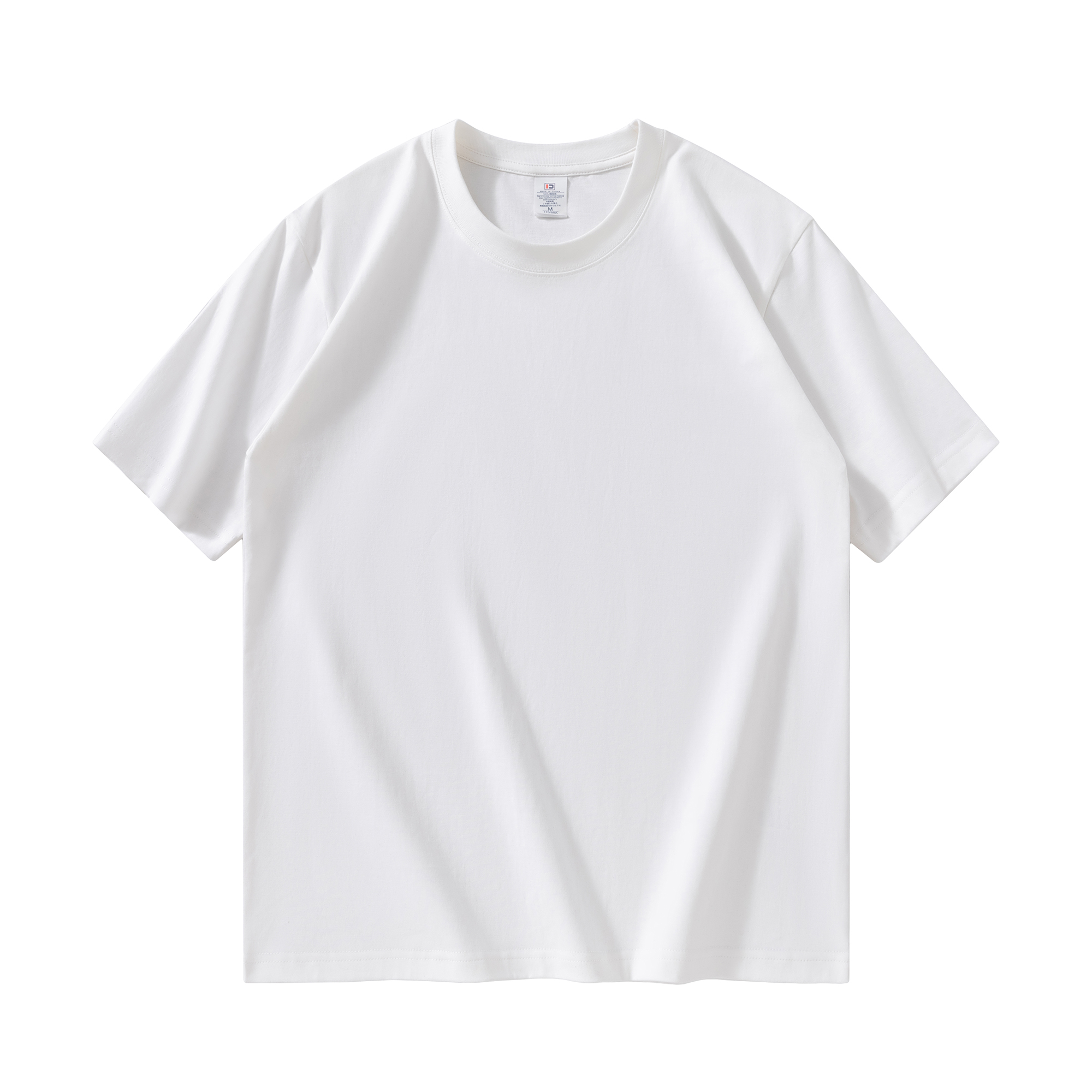
The garment wash does more than soften the hand
Garment washing is the step that separates a blank that feels retail-ready from one that feels like a mill sample. The garment is washed after making up, so the fabric shrinks before the customer sees it, the seams relax, and the surface loses the flat, slightly stiff character of a freshly knitted jersey.
It also changes the numbers on the tech pack. A finished weight of 220 g is measured after washing; the greige fabric that enters the wash trough is heavier, and the exact relationship depends on the wash recipe, the shade and the cotton lot. This is why the same style can be quoted at 220 g on one document and 230 g on another without either being wrong — they are describing different stages. For a bulk order, fix one number, state the stage it refers to, and measure the approved sample on a cutter's scale.
Washing also affects shrinkage tolerance. A single jersey that has been garment washed typically settles at a lower residual shrinkage than an unwashed one, but it is not zero. Buyers should ask for the shrinkage figure measured after three home launderings at 40 °C, because that is the number a retail buyer will test, not the figure from the first wash.
Ten shades, held to a standard
The range runs white, black, dark navy, dark grey, bright red, apricot, bean green, light blue, light grey and ink green. On a basic tee the shade range is the programme: a buyer who cannot reorder the same white six months later has no programme at all.
Shade control starts with the lab dip and ends with the bulk lot. Each shade is approved against a spectrophotometer reading rather than the eye, with a tolerance agreed before production, and the bulk lot is checked against the approved dip under a controlled light source. Pale shades are the difficult end: apricot and light grey show a half-step shift more clearly than navy does, and white is judged on brightness rather than hue.
Where a programme mixes colours across a size run, the shades should be approved as a set, not one at a time. A red that reads correct alone can look orange next to a navy that was approved in a different session, and the set is what the customer sees on the shelf.
The antibacterial finish, and what it can honestly claim
This group carries a 5A physical antibacterial designation, applied so that the finish is bound to the fibre rather than coated on the surface. The purpose is odour control in a garment worn next to the skin: bacteria that break down sweat are inhibited, so the shirt stays fresh for a day of wear rather than a few hours.
Two cautions belong in any buyer conversation. First, the claim is only as good as the test report, and the report has to be run on the finished fabric in the finished shade, because the dyeing and washing steps both affect how much finish survives. Second, an antibacterial finish is not a hygiene product: it does not replace washing, and it should not be marketed as protection against disease. Markets that regulate biocidal claims will ask for the registration, and that paperwork should be settled before the hangtag copy is written, not after.
Durability is measured in wash cycles. Ask how many cycles the finish is specified to survive, and whether the figure comes from the finish supplier or from a test on the garment. The second is the only one that answers the buyer's question. Buyers who want the same finish on a denser ground can specify our antibacterial combed cotton t-shirts, built on the 230 g knit.
Construction details that decide how long it lasts
On a crew neck tee, four construction points separate a garment that survives fifty washes from one that does not.
The collar. A 1x1 rib collar cut on the crosswise grain, with the correct ratio of collar length to neck opening, returns to shape after washing. Too long and it stands away at the front; too short and it pulls the neckline into a gather. The collar is also where the neck tape belongs: a self-fabric or twill tape covers the seam allowance, stops the seam from irritating the neck, and keeps the collar from stretching when the shirt is pulled over the head.
The shoulder. Shoulder seams take the weight of the garment every time it is hung or pulled on. A taped or reinforced shoulder seam prevents the seam from opening at the point where the sleeve meets the body, which is the first place a cheap tee fails.
The hem. A coverstitched hem — two needle rows on the face, a looped stitch on the back — allows the fabric to stretch without cracking the thread. A single row of lockstitch looks identical in a photograph and splits the first time the hem is stretched.
The side seam. A tubular body has no side seam at all, which removes a potential source of twist, but limits the fit shaping a buyer can specify. A cut-and-sew body allows a tapered waist and a curved hem, at the cost of one more seam to control.
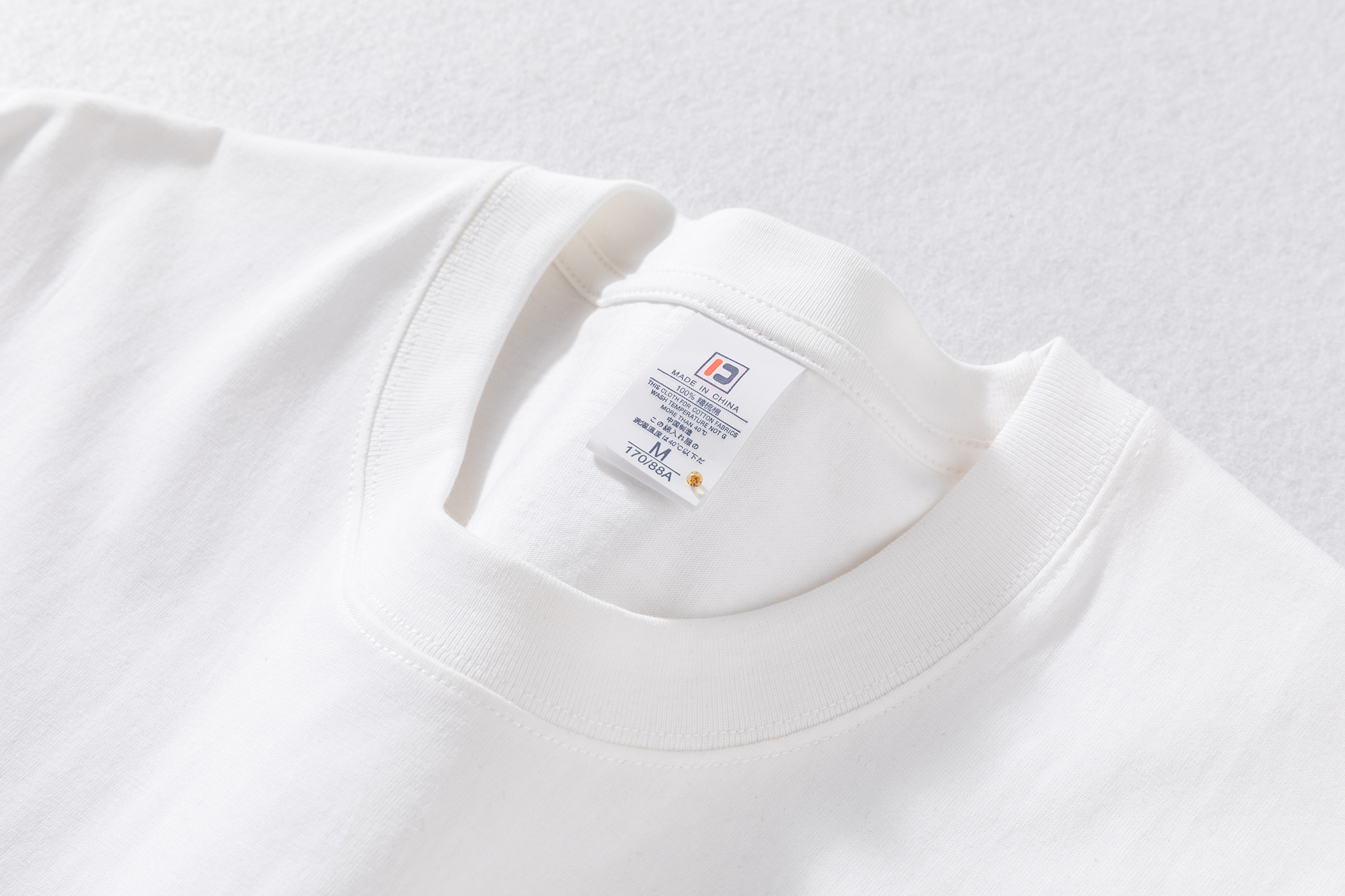
The size chart, in numbers
Measurements below are garment measurements in centimetres, taken flat, with a tolerance of 1–3 cm on a hand-measured production sample.
| Size | Body length | Chest (1/2) | Shoulder | Sleeve |
|---|---|---|---|---|
| M | 69 | 50 | 48 | 22.5 |
| L | 71 | 52.5 | 51 | 23 |
| XL | 73 | 55 | 52 | 23.5 |
| 2XL | 75 | 57.5 | 55 | 24 |
| 3XL | 77 | 60 | 57 | 24.5 |
The block is a regular fit with a straight body and a relaxed shoulder. Reading the grading: the chest grows 2.5 cm per size at the half measure, which is a 5 cm full-chest step; the shoulder jumps 1–3 cm; body length moves 2 cm. That is a conventional men's grading, and it means a buyer can extend into 4XL or XS from the same block without re-cutting the whole pattern, provided the extension is sampled.
Where a programme needs a women's version, the block has to be re-graded rather than scaled down: the shoulder width and sleeve length do not shrink in proportion to chest, and a men's M cut down to a women's M will drop off the shoulder. The wider range of cotton tees and weights is listed under custom t-shirts.
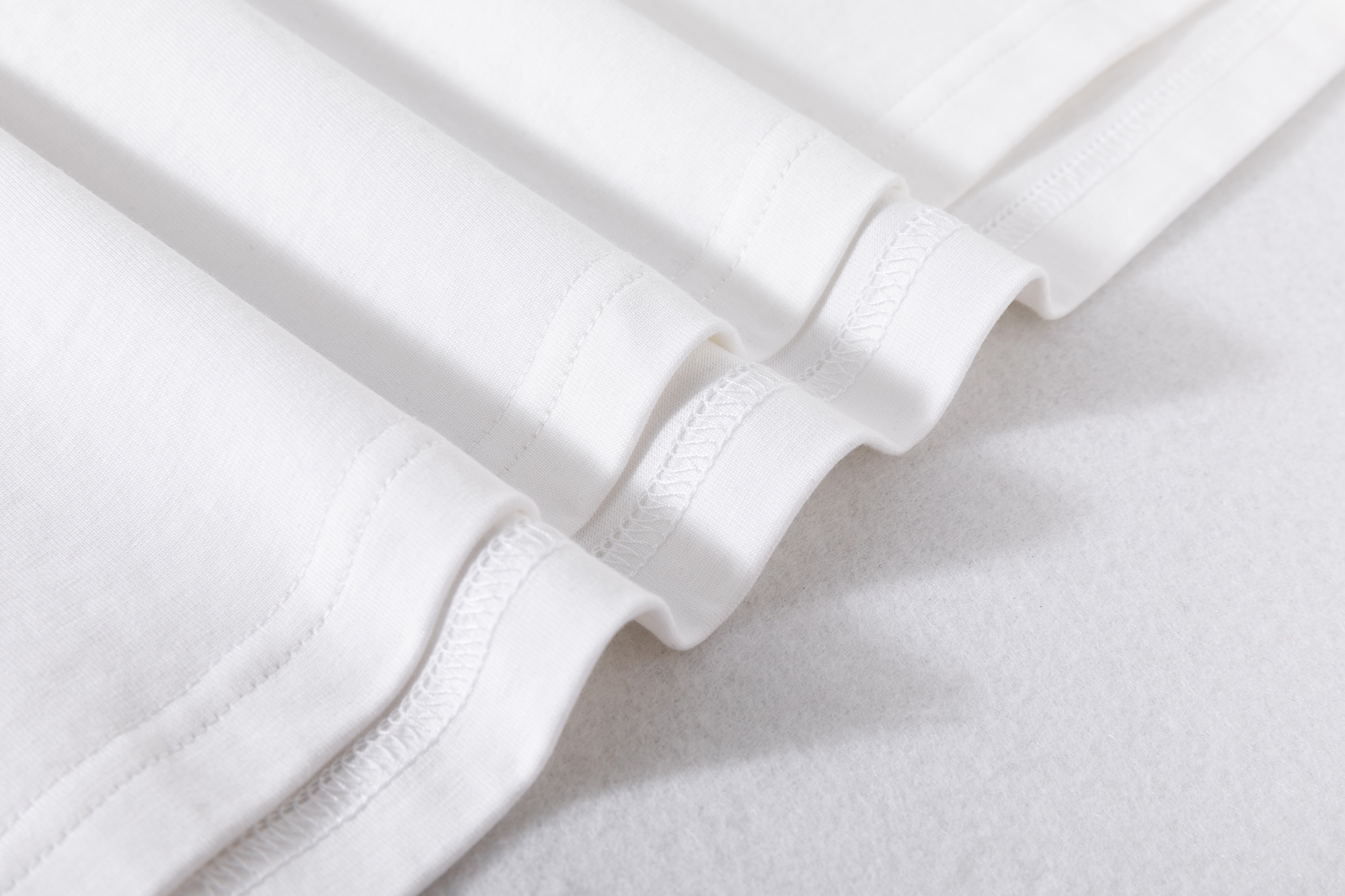
Print surface and decoration
A combed, garment-washed jersey is a good screen print surface: the face is smooth, the ink sits flat, and a plastisol print does not fill in on small type. Water-based and discharge printing both work, though discharge depends on the shade — it reads cleanest on dark grounds and can leave a halo on sulphur-dyed blacks.
Embroidery on a mid-weight jersey needs a backing. Without one, the stitch pulls the knit and the logo cups; with too stiff a backing, the panel shows as a square through the front. A cut-away backing in a weight matched to the stitch count is the usual answer.
Heat transfer and silicone prints suit the smoother shades and are the practical option for small runs and names, because no screen setup is required. On white, the risk is show-through from the inside of the print, which is a backing question rather than an ink question.
Minimums, lead times and inspection
Custom orders start at 200 pieces per style and per colour, with sampling in 5 to 7 working days and bulk production in 15 to 25 days after sample approval and fabric arrival. Stock blanks are held in depth — more than 200,000 units in a 5,000 square metre warehouse — and stock orders can start at ten pieces with dispatch inside three days, which is what makes a colour test or a uniform top-up practical.
Inspection follows the AQL standard across the lot, with manual checks on collar symmetry, neck tape coverage, shoulder seam strength, hem width and dimensional accuracy against the approved sample. Buyers with their own protocol can book a third-party inspection at the factory before packing.
Questions buyers ask before ordering
Is 220 g heavy enough for a retail white tee?
For a warm-weather market, yes. At 220 g after garment wash the fabric is opaque enough in white for a retail hangtag programme, and it stays comfortable in heat. Buyers targeting a colder market or a heavyweight streetwear look usually move up to the 230 g version, which reads denser in the hand and holds a boxier silhouette.
Does the antibacterial finish survive industrial washing?
It is specified as bound to the fibre rather than coated, and it is tested after repeated wash cycles. Ask for the cycle count on the report and match it to the laundering method the end user will actually use — a hotel laundry runs far hotter than a home machine.
Can the neckline be changed without re-cutting the body?
A crew can be moved to a shallow V or a wider scoop from the same body block, but the collar rib, the neck-drop and the neck tape all change with it, and the pattern must be re-sampled. A deeper V also needs a stay to stop the point from stretching.
For buyers building a basics programme, the useful next step is a small stock order in the two shades that carry the line, worn for a week before the bulk commitment. Fabric problems show up in wear, not on a hanger — and a week of wear costs less than a container of the wrong white.
Share to:


