Crew Neck vs V-Neck T-Shirts: Fit Blocks, Grading and Size Runs
Why a crew-neck and a V-neck in the same block can share one size range: neckline geometry, grading math, what a stretch knit needs from tape and backing, and how to specify both styles as one package.
2026/11/20
Reading volume: 0
News Details
Most buyers take crew neck and V-neck for two T-shirts. In a well-made pattern block, they are the same T-shirt with two necklines, and the difference in cost is one collar operation. This distinction matters when the program needs both: a retail line that uses crew neck for logo wear and V-neck for layering pieces can share a body block, a fabric lot, and a size run, which simplifies sampling, bulk production, and reorder.
The two styles below are exactly this case. Style 0802 is a crew neck and style 0803 is a V-neck. Both are cut from the same stretch knit, both run from M to 4XL, and both are measured identically on the body. This guide covers neckline geometry, the grading behind the size run, why a polyester knit can feel like cotton in the hand, and how to specify the two styles so they behave as one program.
One block, two necklines
Comparing the size charts, the two styles share every body measurement: body length 68 cm at M through 77 cm at 4XL, half chest 50 cm through 62.5 cm, shoulder 45.8 cm through 51.8 cm, and sleeve 22.5 cm through 25 cm. The neckline is the only variable.
| Specification | 0802 Crew Neck | 0803 V-Neck |
|---|---|---|
| Fabric | Stretch knit, 100% polyester | Stretch knit, 100% polyester |
| Neckline | Ribbed crew, taped seam | V with taped seam, set depth |
| Size run | M–4XL | M–4XL |
| Colours | 7 shades | 7 shades |
| Hand feel index | Soft, medium weight | Soft, medium weight |
| Functional spec | Outdoor, quick dry, sun and insect protection | One-way wicking, cool touch, sun and insect protection |
Both are sold under the same internal fabric name, a stretch knit developed to feel closer to cotton than to a technical jersey. The shade cards also match: black, pearl white, star grey, khaki, slate, olive, and amber brown. A buyer can therefore run the crew as the logo T-shirt and the V-neck as the layering T-shirt in identical shades, and the two will read as one collection on the shelf.
Why a polyester knit can feel like cotton
The first reaction from most buyers is that a 100% polyester T-shirt will feel slick. It can be — but the hand feel of a knit is determined by yarn and finishing, not only by the polymer. Three levers do most of the work.
Filament denier. Fine filaments bend more easily, so the fabric feels softer and drapes closer to a cotton jersey. A coarse filament at the same fabric weight reads as plastic; a fine one reads as textile.
Surface treatment. A mechanical or chemical softening step breaks the slick face and gives the fabric a dry, slightly matte hand. That is what stops a polyester T-shirt from looking like sportswear under shop lighting.
Knit density. A medium-weight knit with a tight, even surface holds its shape and photographs like cotton, while a loose, open knit reveals its synthetic origin immediately.
The trade-off is honest: a polyester knit wicks and dries faster than cotton, and it holds colour and shape better through washing, but it does not have the dry, absorbent surface of cotton. For a T-shirt worn next to the skin in heat and washed daily, most buyers find the exchange worth making. Buyers who need a genuine cotton face should stay in the cotton group, and the choice between the two is a question of end use rather than price.
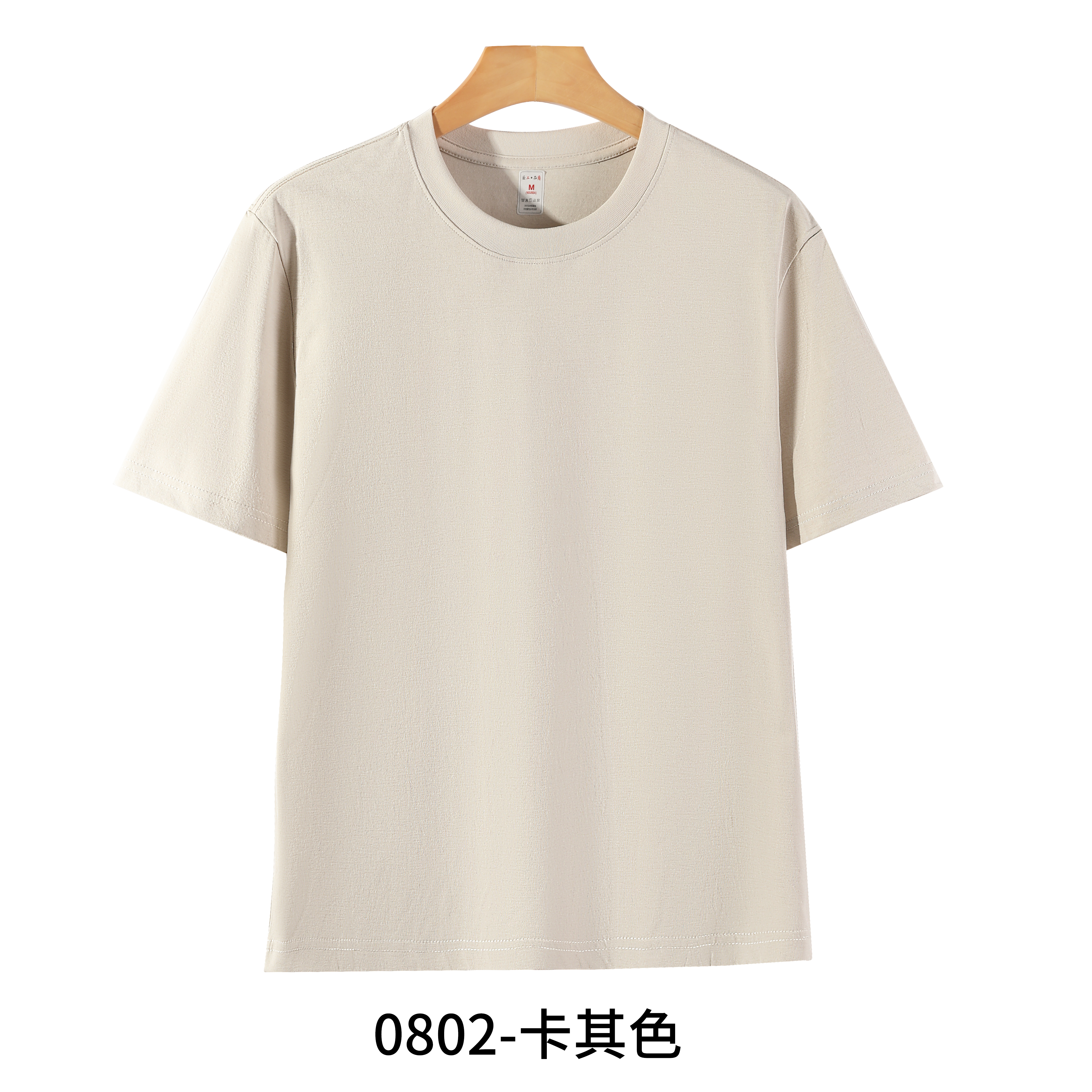
Neckline geometry: where a V-neck succeeds or fails
A V-neck is a pattern decision with three numbers: the depth of the point, the width of the neck opening at the shoulder, and the angle of the V. Get the ratio wrong and the T-shirt pulls, gaps when the wearer bends, or shows more chest than the customer intended.
Depth. A shallow V that ends 6–8 cm below the collarbone reads as a layering T-shirt and works under a jacket. A deeper V reads as a fashion piece and needs a wider neck opening to avoid pulling at the point. On a stretch knit the V also opens slightly in wear, so the pattern depth is usually cut a few millimetres shallower than the intended finished depth.
Width. The neck opening at the shoulder line controls how the T-shirt sits. Narrow and the V looks pinched; wide and the shoulder seam slides toward the arm. On the 0803 the opening is set to the same shoulder point as the crew, which is why the two styles can share a body block.The tape. The V point is the highest-stress point on the garment: every time the T-shirt is pulled over the head, the point takes the load. A taped seam — a strip of self-fabric or twill covering the seam allowance from shoulder to shoulder through the point — spreads that load and stops the point from stretching into a rounded dip. Without it, a V-neck fails at the point long before the body wears out.
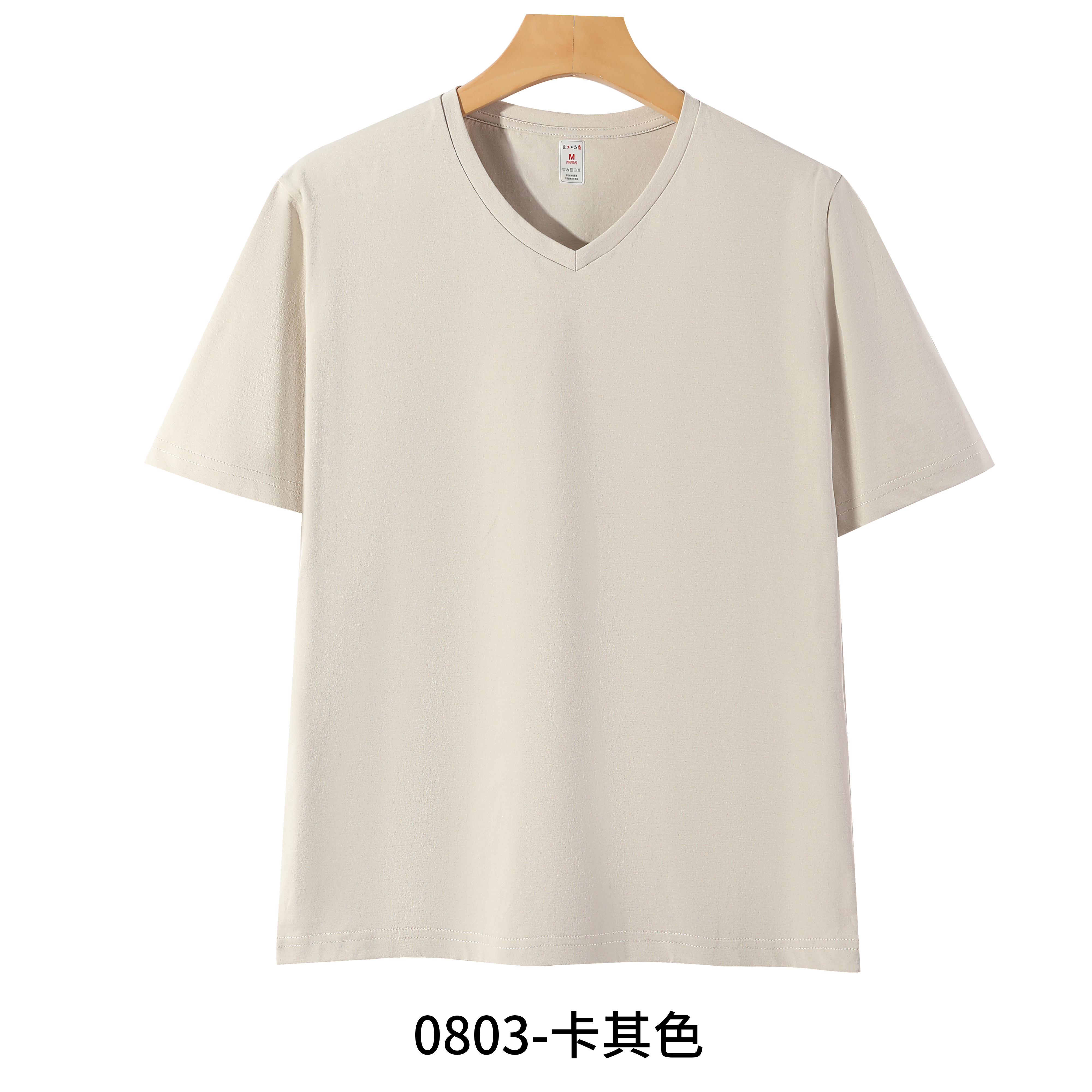
The grading behind the size run
Both styles run M to 4XL, and the grading is conventional: half chest grows 2.5 cm per size, body length 2 cm at the first step and 1 cm at the top, shoulder roughly 1.2 cm, and sleeve 0.5 cm. The suggested body ranges on the chart step from 160–165 cm at M to 185–190 cm at 4XL, with a corresponding weight band.
| Size | Body length | Chest (1/2) | Shoulder | Sleeve |
|---|---|---|---|---|
| M | 68 | 50 | 45.8 | 22.5 |
| L | 70 | 52.5 | 47 | 23 |
| XL | 72 | 55 | 48.2 | 23.5 |
| 2XL | 74 | 57.5 | 49.4 | 24 |
| 3XL | 76 | 60 | 50.6 | 24.5 |
| 4XL | 77 | 62.5 | 51.8 | 25 |
Two things are worth checking against a buyer's own block. First, body length holds nearly flat from 3XL to 4XL at 1 cm, which suits a market where larger sizes are worn by taller wearers rather than wider ones; a market that expects a longline fit will need the 4XL extended. Second, the sleeve grows only 0.5 cm per size, which is correct for a set-in sleeve where the cap height does not change but will feel short on a very tall 4XL wearer.
Where a program needs XS or 5XL, both are separate patterns rather than a scaled step, and both should be sampled. Extending a graded nest by formula is how a size run ends up with a 5XL that has a 3XL sleeve.
Fit decisions that change the order
Shoulder drop. A relaxed shoulder — the seam sitting 1–2 cm past the shoulder point — reads modern and is more forgiving across body shapes. A set-in shoulder reads sharper and suits a uniform. Both styles here sit on the relaxed side.
Body width versus length. For a streetwear program, buyers usually want chest and length to grow together; for a workwear program, chest grows while length holds. Fix the ratio in the tech pack, because it determines the pattern, not the fabric.Hem. A straight hem is the default and the cheaper option. A curved hem with a dropped back adds fabric and a second operation, and on a stretch knit it needs a coverstitch to avoid a wavy edge.
Layering. A V-neck worn under an overshirt should be cut close enough at the chest that it does not bunch, which usually means the layer version is one size down from the outer garment. It is worth stating this in the size guidance rather than leaving the customer to discover it.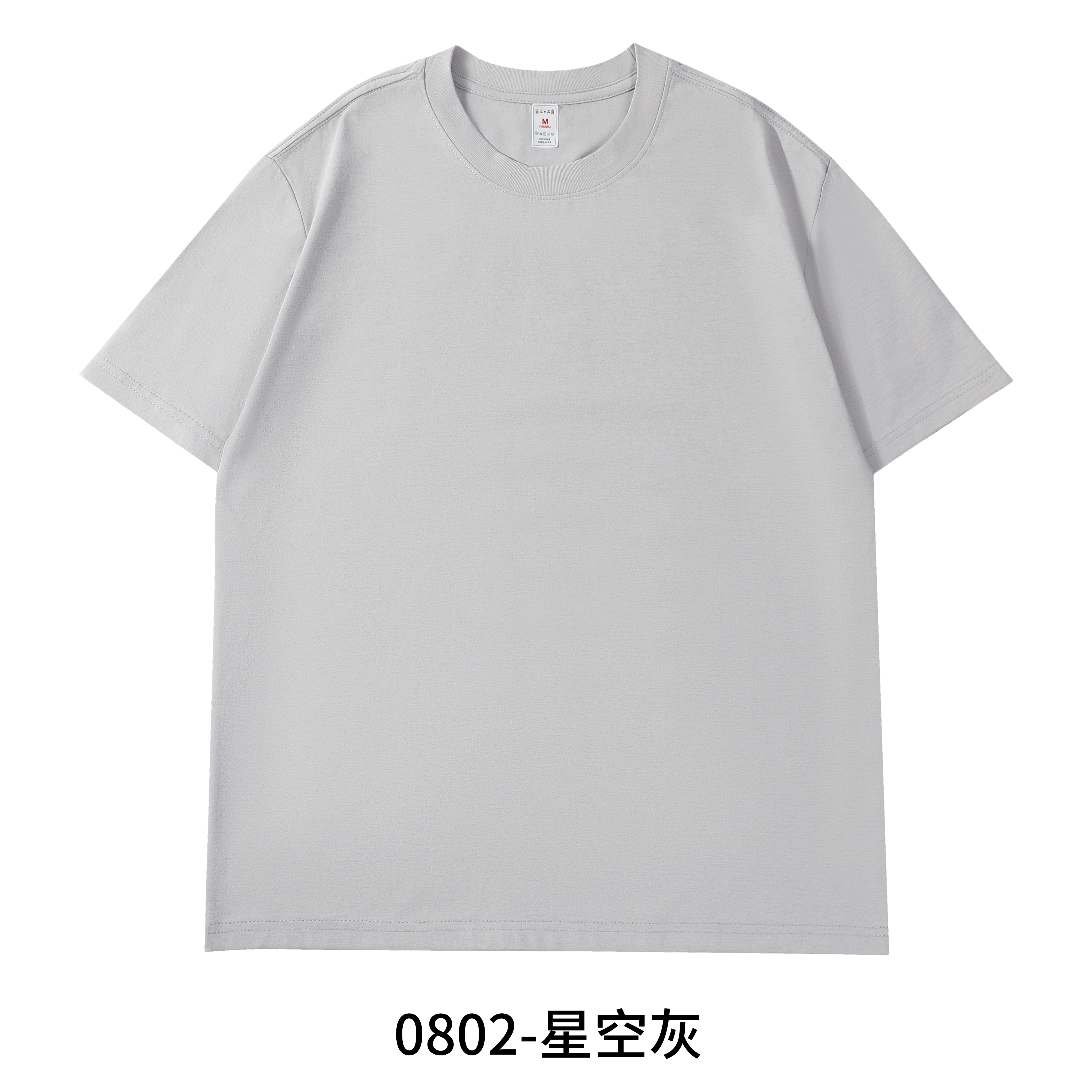
The functional side of the fabric
Stretch knits in this group are specified with one-way moisture transport: liquid moves from the skin side to the face side and spreads there, so it evaporates instead of sitting against the body. The fabric is also described as cool to the touch, with a sun-protection and insect-repellent finish offered on the outdoor version.
Those are fabric-level claims and they need fabric-level evidence. Any UPF figure, repellent efficacy, or wicking rate that appears on a hangtag should come from a test on the finished fabric in the finished shade, and the report should travel with the shipment. Where a market regulates the claim, the report is the product. Our quick-dry V-neck cooling T-shirts carry that specification in the V silhouette, and the collared version of the same knit is listed as high-elastic stretch collared T-shirts for buyers who need a collar on the same fabric.
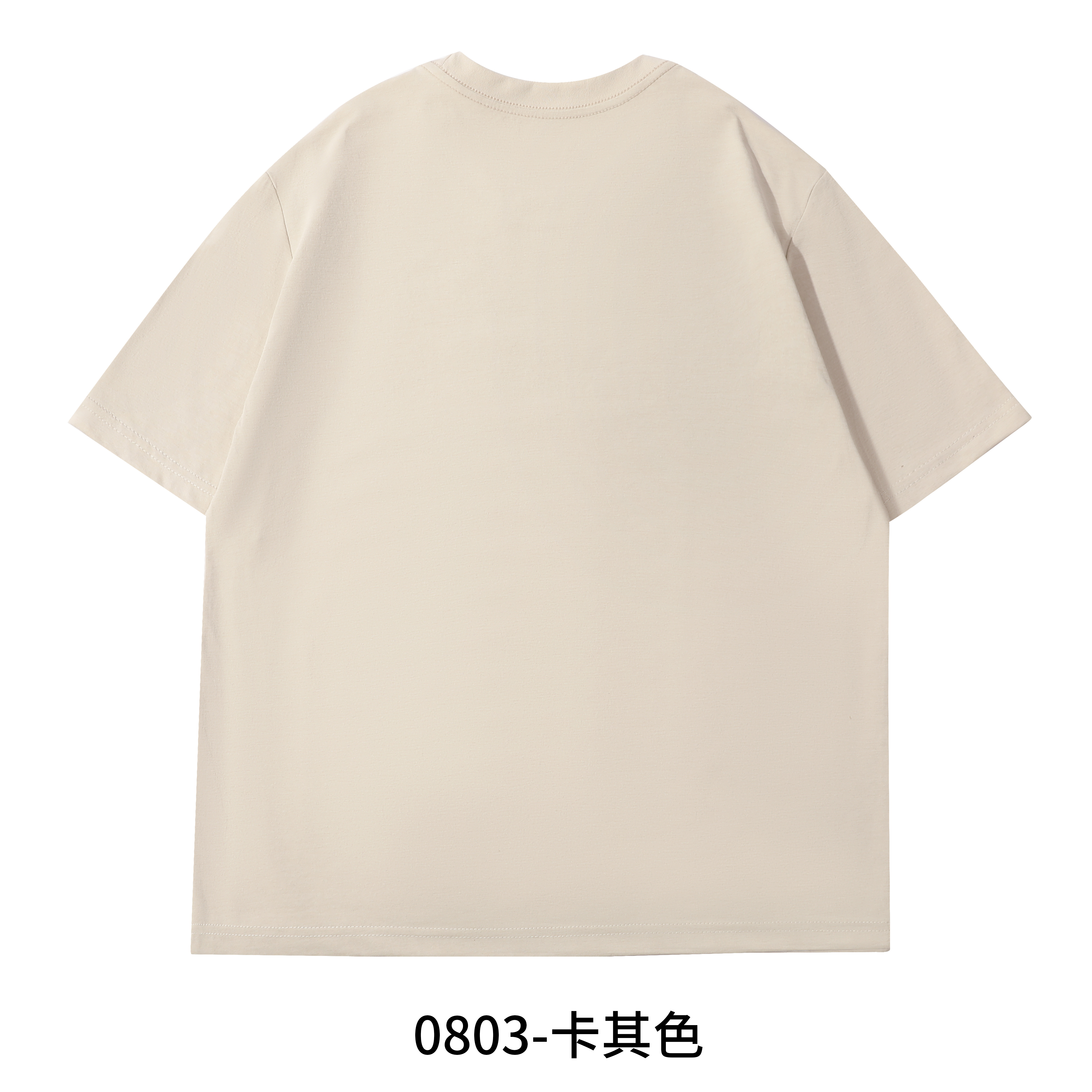
Decoration on a stretch knit
Stretch changes the decoration rules. A plastisol block printed across a wide panel will crack at the edges as the fabric moves, so large solid prints are usually placed high on the chest or reduced in size. Silicone transfer, 3D gel, and reflective prints suit the smooth face and stay legible on small type.
Embroidery needs a backing matched to the stretch: a soft cut-away works, a stiff tear-away will show as a square and can pucker the panel. On a V-neck, a left-chest logo should sit clear of the neckline tape, or the embroidery will catch the tape edge and distort it.
Heat-seal neck labels, printed care tapes, and woven side tags are applied during finishing and must be confirmed before production. On a stretch knit the neck label matters more than usual, because a stiff woven label on a soft neckline is the first thing a wearer notices.
Minimums, stock, and lead times
Both styles run from stock: more than 200,000 blank units across the range sit in a 5,000 square metre warehouse, stock orders can start at ten pieces, and dispatch is within three days. For a program that needs a colour test before a bulk commitment, that is the cheapest way to evaluate hand feel and fit.
Custom orders start at 200 pieces per style and per colour, with sampling in 5 to 7 working days and bulk in 15 to 25 days after approval. Inspection follows the AQL standard across the lot, with manual checks on neckline symmetry, tape coverage, shoulder seam strength, hem width, and measurements against the approved sample. The wider range sits under custom T-shirts.
Questions buyers ask before ordering
Can the crew and the V share one size run?
Yes. Body measurements are identical across both styles, so a size breakdown and colour allocation can be split between the two necklines without re-grading. The only thing that changes is the neckline operation and its trim consumption.
Does the V-neck stretch out?
The V point is the stress point, and it is controlled by the tape and by cutting the point a few millimetres shallower than the finished target. A taped V that is sampled and washed before approval holds its line; an untaped V on a stretch knit will round out.
Will a polyester T-shirt feel hot?
Less hot than the composition suggests. The knit is specified for one-way transport and cool touch, and a medium-weight fine-filament knit moves vapour well. It will not feel like cotton against the skin, and buyers who need that specific sensation should specify the cotton group instead.
For a range that carries both necklines, the practical route is a stock order in the two shades that anchor the line, worn and washed for a week, followed by a bulk order that fixes trim, label, and print placement. The neckline decision is the easy part — the fabric and finish are what the customer will judge in the second month.
Share to:


