Brushed Cotton Long Sleeve Shirts: Napping, Warmth and Raglan Build
Why a Brushed Cotton Long-Sleeve Feels Warm Without Feeling Heavy: Napping, Yarn and Knit Choices That Control Pilling, Raglan vs. Set-In Shoulders, Neckline and Cuff Construction, and What to Fix Before Bulk Production
2026/11/20
Reading volume: 0
News Details
A brushed cotton long sleeve is the garment a buyer reaches for when a plain tee is not warm enough and a sweatshirt is too much. It sits in the gap between the two, and the gap is narrower than it looks: the fabric has to be light enough to wear indoors all day, warm enough for an unheated room, and stable enough that the nap does not ball up after five washes.
Our brushed cotton group is built exactly for that position — a crew neck long sleeve in a cotton knit with a lightly raised face, cut in a soft palette that runs from white through oatmeal to khaki, with a raglan variant in style 1807. This guide explains how the nap is produced, what it does to warmth and durability, how the raglan build differs from a set-in shoulder, and what to settle in the tech pack before a bulk run.
What brushing actually does
Brushing — napping, in mill language — raises fibre from the surface of a knitted fabric by passing it against revolving wire-covered rollers. The result is a fine, even layer of fibre standing up from the face, which changes three properties at once: the fabric feels softer against the skin, it looks matte rather than flat, and it traps a thin layer of still air next to the body.
That last effect is the reason the garment is warm without being heavy. Still air is the best insulator a textile has, and a brushed surface holds it in a way a smooth jersey cannot. A lightly napped cotton knit at a moderate weight reads warmer than a smooth knit of the same weight, which is what makes a long sleeve wearable indoors where a fleece would be too much.
Brushing is also irreversible in one direction: once the fibre is raised, the surface is more open, and the fabric will pill more readily than the same knit left smooth. That is the trade every buyer makes, and it is why the fibre choice and the wash instructions matter more on a brushed style than on a plain one.
Brushed is not fleece
The two are often confused in product copy, and the confusion costs buyers money. A fleece is knitted with an extra yarn that is cut and brushed on the inside to create a deep pile; it is thick, it insulates strongly, and it is a sweatshirt fabric. A brushed jersey is a single knit whose face has been raised lightly: the fabric stays thin, drapes like a tee, and warms by trapping air in the nap rather than by bulk.
In practice, a brushed cotton long sleeve is a layering garment worn against the skin or over a tee. A fleece is an outer layer. Selling one as the other produces returns, because the customer who expected a sweatshirt gets a shirt and the customer who wanted a shirt gets a jacket.
The correct description names the process and the weight class: a brushed cotton jersey, light enough to layer, warm enough for indoors. Avoid fleece-lined unless there is a pile, and avoid thermal unless the fabric has been tested for thermal resistance.
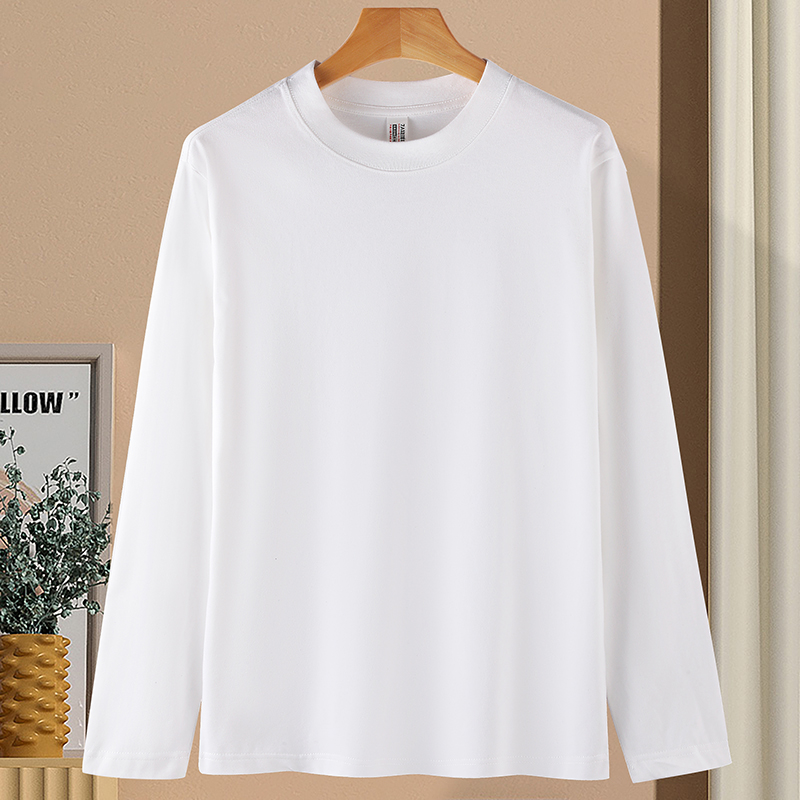
Where the softness comes from
Three variables decide how a brushed cotton feels, and only one of them is the brushing itself.
The yarn. Combed cotton produces a cleaner, more uniform nap because the short fibres have been removed before spinning. Carded cotton brushes up fuzzier and softer at first touch, then pills faster, because the short fibres that create the initial softness are also the ones that migrate into pills.
The knit. A tighter, denser knit holds the raised fibre in place. A loose knit releases it, so the surface goes bald in the wear areas — under the arm, at the cuff, across the seat — while the rest of the garment still looks new.
The brush depth. A light pass gives a soft hand with good durability. A deep pass gives a plush, almost sueded surface that photographs beautifully and wears out quickly. Most retail programmes land in the middle, and the depth should be written into the approval sample so that a reorder matches.
The index on our own style card rates the fabric soft, the stretch medium and the thickness medium — a useful shorthand for a buyer comparing it against a smooth jersey and a fleece in the same session.
The raglan build, and why it suits a soft knit
Style 1807 uses a raglan shoulder: the seam runs diagonally from the underarm to the neckline instead of sitting on top of the shoulder. On a brushed knit the raglan does two useful things.
First, it removes the shoulder seam from the highest point of the garment. That seam is where a soft knit most often puckers, because the fabric is stretched over the shoulder point during sewing and then relaxes. A diagonal seam distributes the same load along a longer line, so the shoulder stays flat.
Second, it changes the fit. A raglan has no shoulder point to align, so it accommodates a wider range of shoulder widths within one size, which reduces size-related returns in a programme sold online. The trade is a more casual look: a raglan reads as a knit top, where a set-in shoulder reads as a shirt.
For a programme that wants a sharper line under a jacket, the set-in crew is the better choice; for a programme selling comfort, the raglan usually wins. Both are available in the group, and the choice should be made before sampling rather than after, because the two need different patterns and different marker layouts.
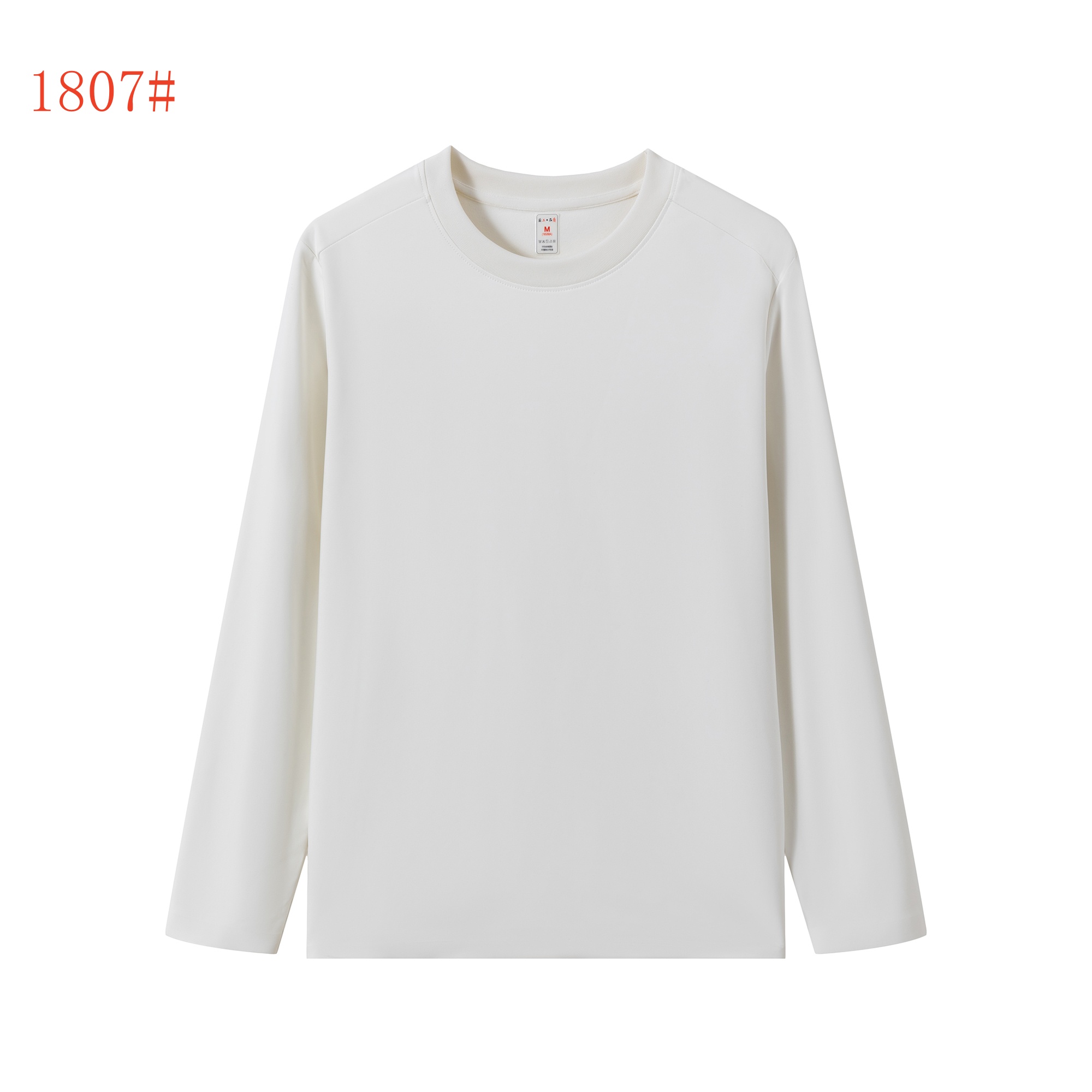
Neckline, cuffs and hem
On a long sleeve, the three finishing points a customer touches first are the neck, the cuffs and the hem, and each has a failure mode.
The neck. A crew neck on a brushed knit needs a rib that is firm enough to hold its shape but soft enough not to feel like a band. The collar is cut to a set ratio against the neck opening, and the seam is taped so the neck does not stretch when the garment is pulled on. On a soft knit the tape also stops the seam allowance from curling, which is what produces the wavy neckline that shows up after the first wash.
The cuffs. A ribbed cuff with elastane holds the wrist and stops the sleeve from riding up under a jacket. A plain folded hem is cheaper and reads cleaner, but it will stretch with wear. On a brushed knit, a rib cuff also protects the sleeve end from the abrasion that causes pilling.
The hem. A coverstitched hem allows the fabric to stretch, and on a long length it prevents the wavy edge that a lockstitch produces. A straight hem reads casual; a curved hem with a slightly dropped back reads more considered and covers the waistband when the wearer sits.
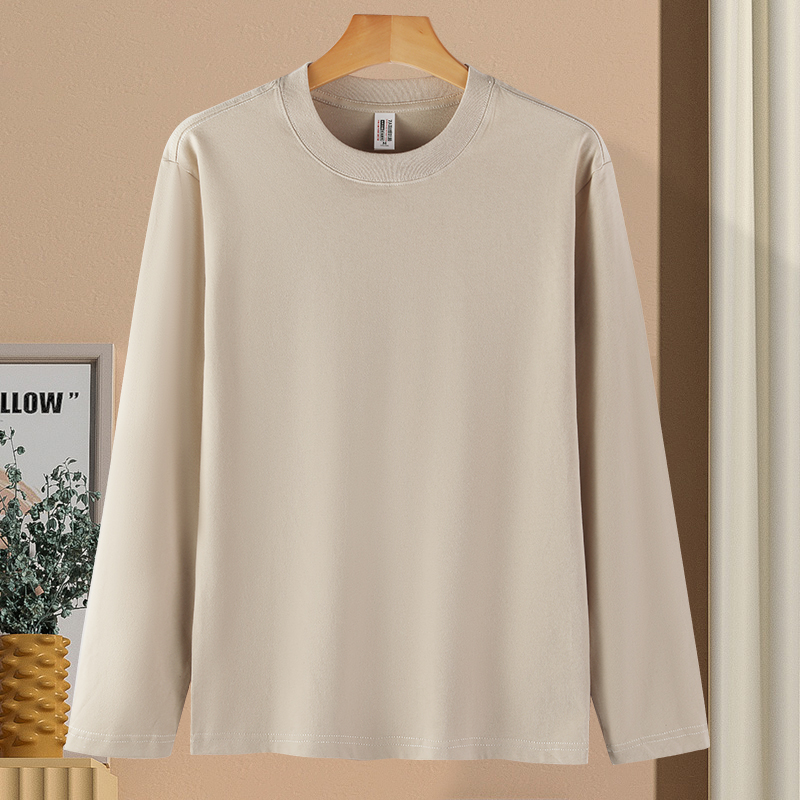
Pilling, and how to specify against it
Pilling is the main complaint on any brushed cotton, and it is a testable property rather than a matter of luck. The standard test tumbles the fabric against itself for a set number of cycles and grades the surface against a photographic scale. A buyer can ask for the grade and for the cycle count behind it.
Three decisions reduce pilling before the test is even run. Combing the yarn removes the short fibres that form pills. A tighter knit holds the fibre in the fabric instead of on it. A lighter brush pass leaves less loose fibre on the surface to begin with. All three cost money, and all three show up in the second month of wear rather than the first.
Care instructions do the rest. Washing inside out, at a low temperature, with a short cycle and no fabric softener keeps the nap from matting; tumble drying on high heat is what turns a soft brushed surface into a flat, hard one. For a retail programme, the care label is a product decision, not a formality — a brushed cotton sold with a hot-wash, hot-dry instruction will generate returns that no fabric upgrade can prevent.
Decoration on a napped surface
Embroidery works well on brushed cotton, provided the backing is chosen for the nap. A soft cut-away backing supports the stitch without creating a hard square, and a light underlay stops the design from sinking into the pile. Fine detail is the limit: on a napped surface, lettering below about 4 mm fills in, because the surrounding fibre closes over the stitch.
Screen printing is possible but less forgiving. The ink sits on the nap rather than on a flat face, so edges soften and a fine halftone loses definition. Water-based inks work better than plastisol because they penetrate instead of sitting on top, and discharge printing reads well on the darker shades where the nap is visible.
Heat transfer and silicone prints are the practical option for small runs and names, applied with a pressure and temperature matched to the fabric so the nap is not crushed into a permanent shiny patch. On a pale shade, a crushed nap shows as a ghost of the print long after the print itself has gone.
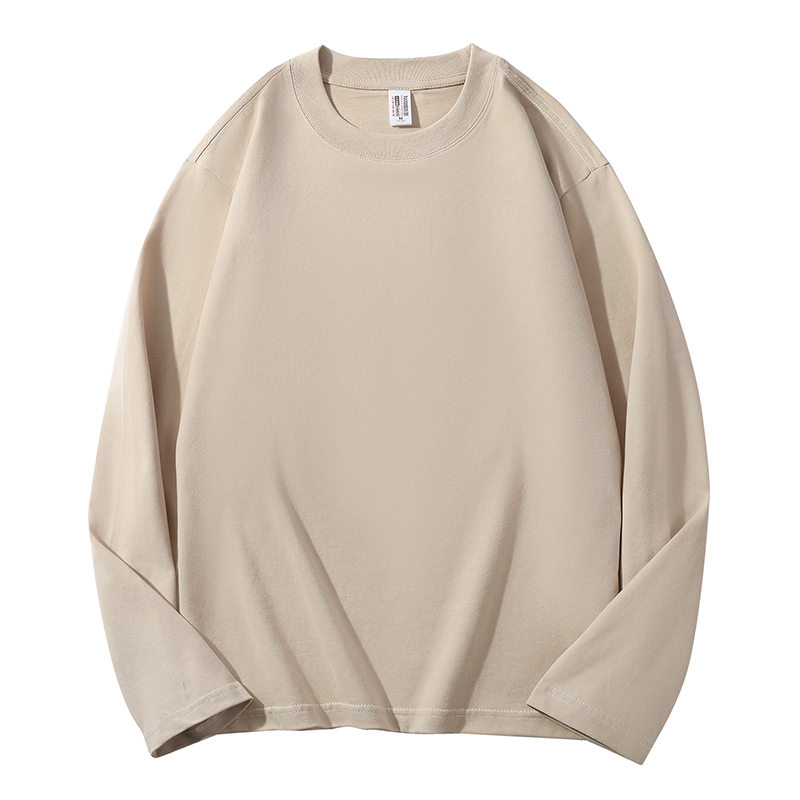
Shade range and the pale-shade problem
The group runs a soft palette: white, oatmeal, khaki and a set of muted tones that sit well together in a capsule. Pale, low-chroma shades are harder to hold than dark ones, for two reasons. The dye has less depth to hide variation, and the nap scatters light, so a half-step shift in shade reads as a change in texture rather than a change in colour.
That makes the lab dip and the bulk lot check more important than usual. The dip should be approved on the brushed fabric, not on a smooth swatch of the same shade, because the nap changes how the colour reads. Where a programme mixes shades, approve them as a set under one light source; a white that reads correct alone can look blue next to an oatmeal that was approved in a different session.
Minimums, lead times and inspection
Custom orders start at 200 pieces per style and per colour, with sampling in 5 to 7 working days and bulk production in 15 to 25 days after sample approval and fabric arrival. Stock blanks are held in depth — more than 200,000 units in a 5,000 square metre warehouse — and stock orders can start at ten pieces with dispatch within three days.
Inspection follows the AQL standard across the lot, with manual checks on neckline symmetry, cuff and hem width, nap consistency across panels, seam strength and measurements against the approved sample. Nap consistency is the check that is specific to this fabric: a sleeve cut from a different end of the roll can read a shade lighter than the body even when the dye lot matches.
For buyers who want a set-in shoulder rather than the raglan, our men's long sleeve crewneck shirts show the set-in build, and the wider custom long sleeve shirts for men programme covers the set-in and collared options on the same finishing line.
Questions buyers ask before ordering
Is a brushed cotton warmer than a plain cotton jersey?
At the same fabric weight, yes — the nap traps a layer of still air, which is what insulates. It will not match a fleece, because a fleece carries a pile rather than a nap. If the end use is outdoor wear in cold weather, the brushed jersey should be specified as a base layer, not as an outer layer.
Will the surface go bald where it rubs?
Only if the knit is too loose or the brush pass too deep. A tighter knit with a light nap keeps the fibre anchored, and the wear points — under the arm, at the cuff — stay even. Ask for the approval sample to be washed and rubbed before sign-off rather than judged on a hanger.
Can it be sold as a thermal?
Only with a thermal resistance test on the finished fabric, because the word implies a measured insulation value in most regulated markets. Brushed cotton, warm without weight is accurate and defensible without a test report. A thermal claim is not.
For a programme built around layering, the practical order is one style in two shades — a pale and a mid tone — sampled in both the raglan and the set-in shoulder, worn for a week and washed twice before the bulk commitment. On a napped fabric that week answers the questions a photograph cannot: how the surface ages, how the neckline behaves, and whether the warmth is right for the market. The full range of lengths and finishes sits under custom long sleeve shirts.
Share to:


