custom quarter-zip pullovers custom quarter-zip pullovers for men custom quarter zip pullover embroidered quarter zip pullover quarter zip pullover men mens quarter zip pullover quarter zip pullover women mens quarter zip pullover fleece quarter zip quarter zip sweater custom quarter zip half zip pullover quarter zip fleece men's quarter zip pullover quarter zip fleece pullover quarter zip sweatshirt quarter zip jacket quarter zip shirts custom quarter zip pullover quarter zip sweater men women's quarter zip pullover mens quarter zip pullover quarter zip pullover quarter zip sweatshirt men quarter zip tops custom quarter zip pullover quarter zip fleece custom quarter zip pullovers mens quarter zip pullover quarter zip pullover mens quarter zip pullover fleece quarter zip pullover men quarter zip fleece quarter zip pullover women quarter zip quarter zip sweatshirt quarter zip jacket quarter zip sweater quarter zip fleece pullover men's quarter zip pullover quarter zip shirts custom quarter zip half zip pullover quarter zip sweater men women's quarter zip pullover quarter zip sweatshirt men quarter zip tops
The specification details for a quarter-zip pullover, including: zipper tape, slider specifications, placket length, collar height, raglan sleeve vs set-in sleeve, logo placement around the zipper, and sampling.
2026/11/16
Reading volume: 1
News Details
A quarter-zip pullover seems like a simple piece to source: a body, two sleeves, a collar and a short zip. In production, however, it is the zip that decides whether the piece feels like outerwear or like a t-shirt with a metal tag at the neck, and the collar stand that decides whether it photographs well enough to sell at the price the buyer has in mind.
This guide sets out how the quarter-zip styles in our range are constructed, what distinguishes a jersey pullover from a fleece sweatshirt, and the details that should be confirmed before a 200-piece run is finalized. It is written for buyers sourcing custom zip-up hoodies and pullovers for outdoor, corporate and streetwear programs.
The zipper placket is where quality becomes apparent first
Four common issues can arise with a quarter zip, and all four are visible without even opening the garment.
The first is the zipper tape. A zipper set into a knit requires an interfaced placket; otherwise, the tape will pucker along its length, causing the front of the garment to wave. On stretch knits, this problem becomes apparent only after the first wash, which is why pre-production samples must be washed before approval, rather than just photographed.
The second is the slider. A semi-auto-lock slider holds the zipper at the position where the wearer leaves it; a plain auto-lock or a cheap open slider will slide down during wear. On Style 1802, the placket features a smooth metal pull with a self-fabric chin guard, which keeps the metal away from the skin when the collar is closed.
The third is the placket length. A quarter zip that ends too high resembles a polo; one that ends too low becomes a full-zip jacket without the necessary hem details to support it. The typical range is 18 to 22 cm from the collar seam, and the correct length depends on the collar height rather than the body length.
The fourth is the bottom stop. It must be positioned high enough above the chest so that any logo placed below it remains uninterrupted, and low enough below the collar that the garment can be pulled over the head without stretching the neckline.
Jersey pullovers and fleece sweatshirts are distinct products
The two categories share a silhouette, but that is about it. A jersey quarter zip is worn next to the skin or over a tee in mild weather; a fleece quarter-zip sweatshirt, on the other hand, is outerwear. Fabric weight, collar height, ribbing and seam allowance all change accordingly.
| Style | Fabric | Sleeve | Key Details | Season |
|---|---|---|---|---|
| 1802 | High-elastic tech blend, 4-way stretch | Raglan | Micro-perforated side vents, chin guard | Spring to autumn |
| 1805 | Same stretch family | Set-in | Zippered chest pocket, stand collar | Spring to autumn |
| 1908 | Fleece or French terry, or tech blend | Raglan | Ribbed cuffs and hem, curved side seams | Autumn to winter |
The quarter-zip long-sleeve pullovers in Style 1802 are the technical option: a dense knit that holds a crease-free line, four-way stretch, and side panels perforated for airflow. They are suitable for golf, training and corporate programs that require a technical look without sportswear logo culture. The men's quarter-zip pullover with chest pocket adds the feature buyers most frequently request after the first season, as a zippered pocket distinguishes a workwear pullover from a fashion one.
The custom raglan quarter-zip sweatshirts in Style 1908 offer a different proposition. The body can be cut from heavy French terry, brushed fleece, or a polyester-spandex blend, and the ribbed cuffs and hem help maintain the shape of a hoodie-weight garment. While the jersey styles are sold as a layering piece, this one is sold as the outer layer.
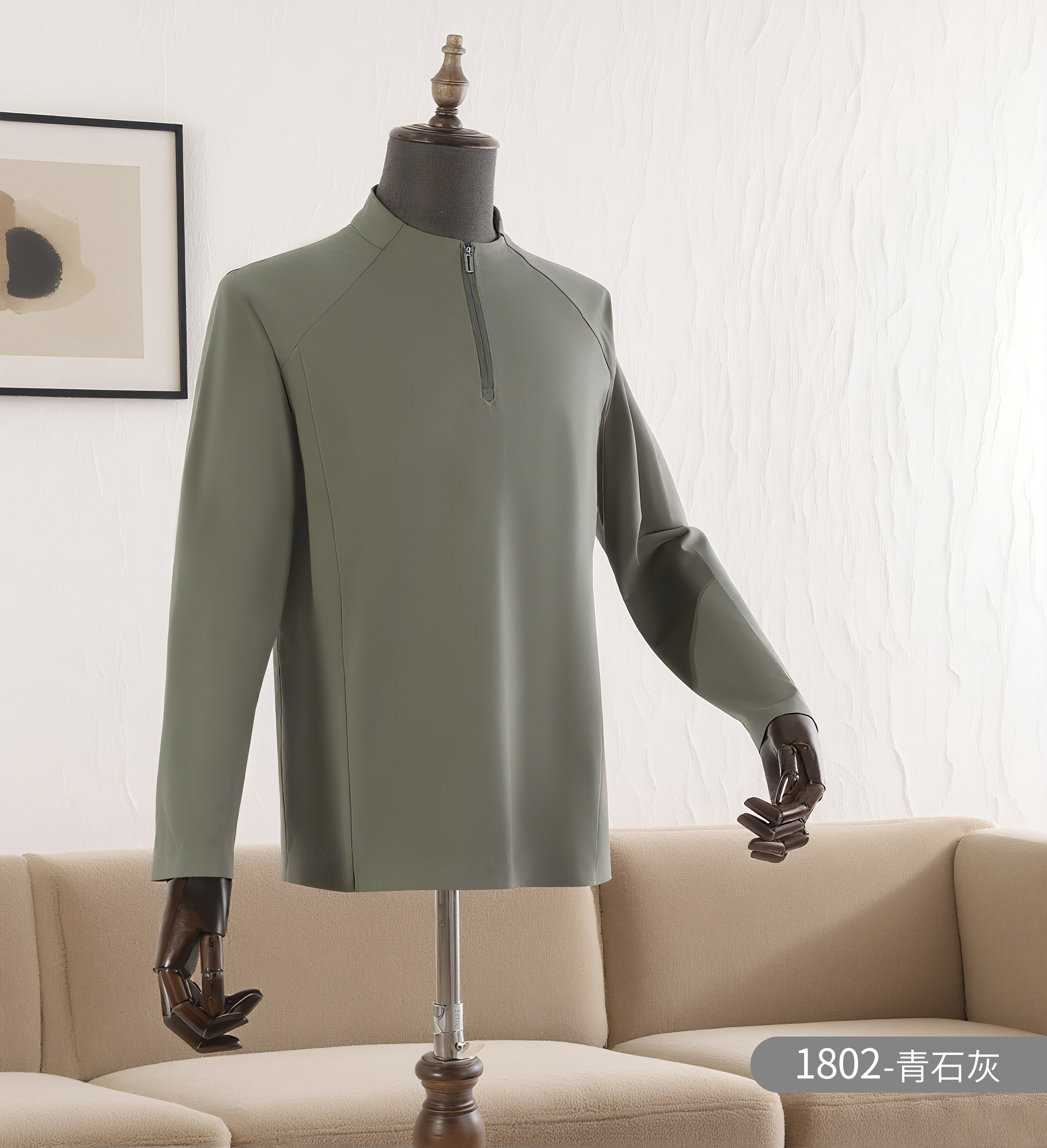
The height of the collar stand affects the entire garment
A 7 to 8 cm stand collar fits neatly under a jacket collar and looks polished when zipped to the top. A shorter 5 to 6 cm collar resembles a polo neckline and is better suited to warmer markets, where a high stand may feel restrictive. The difference is subtle on paper but obvious during a fitting.
Two details determine whether the collar maintains its shape. The first is the interfacing: a soft fusible keeps the stand upright without making it stiff, while an unfused stand will lose its structure after two washes. The second is the seam joining the stand to the body. On a raglan style, the collar seam bears more stress than on a set-in style, as the shoulder seam meets it at an angle, so it is usually taped or top-stitched for added stability.
The chin guard is worth highlighting for buyers who have not specified one previously. It is a small piece of self-fabric folded over the top of the zipper, and without it, the metal slider rests against the throat when the collar is closed.
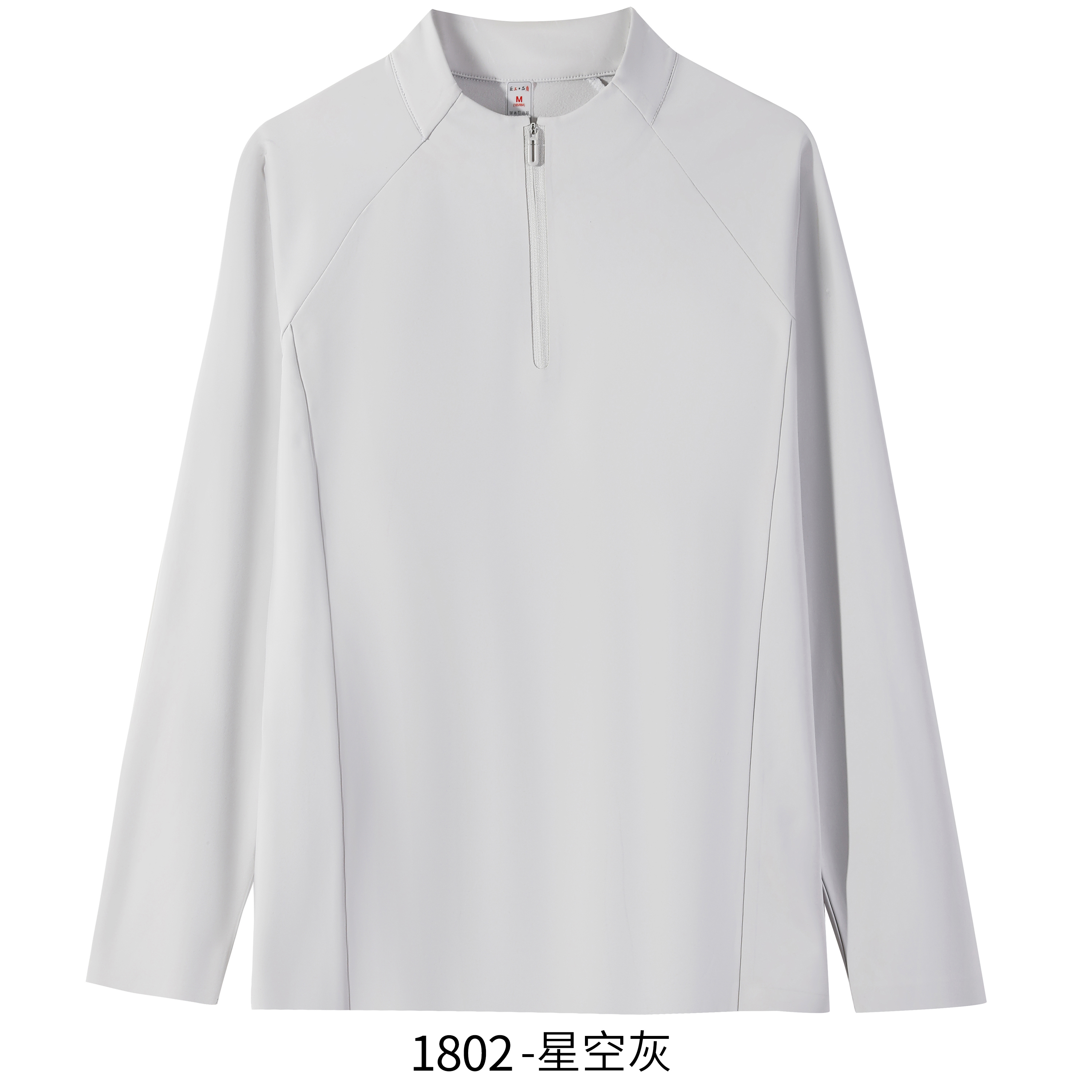
Raglan or set-in: how the construction affects movement
A raglan seam runs diagonally from the underarm to the collar, eliminating the shoulder seam and providing the arm with a wider range of motion. On a quarter zip, this is the more practical construction for active use, as the garment does not pull across the back when the wearer reaches forward.
A set-in sleeve creates a sharper shoulder line and a more conventional look, which is why the pocketed 1805 uses this style. The trade-off is that a set-in armhole requires more ease at the chest to avoid restriction, so the same nominal size will feel looser through the body.
Neither construction inherently costs more; what incurs costs is inconsistency. A raglan seam that meets the collar at different points on each side is considered a defect.
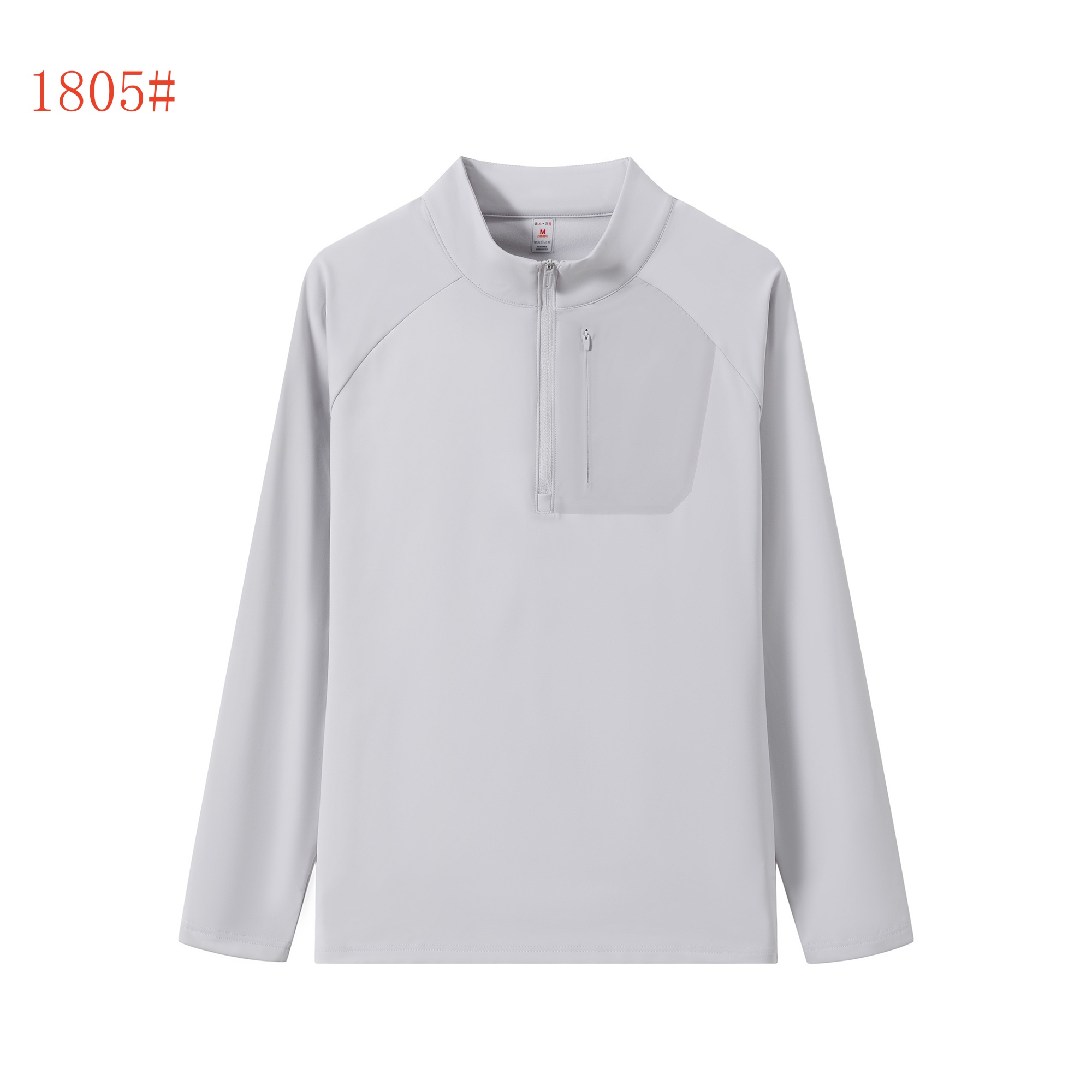
Placing a logo near a zipper
The placket divides the front of the garment, so a centered chest logo must be positioned either above it, below it, or to one side. Below the bottom stop is the typical placement for embroidery: the fabric lies flat, the needle avoids the zipper, and the logo remains visible when the collar is open.
Left-chest placement works for both jersey and fleece, but embroidery requires backing on stretch knits to prevent the panel from puckering, and the design should avoid sharp vertical edges that run parallel to the zipper tape.
For heat transfer and silicone applications, the smooth tech-blend surface of 1802 accommodates fine details well. On brushed fleece, the surface texture shows through thin transfers, so a slightly heavier application is necessary. This must be tested on the actual fabric rather than on a swatch of a different weight.
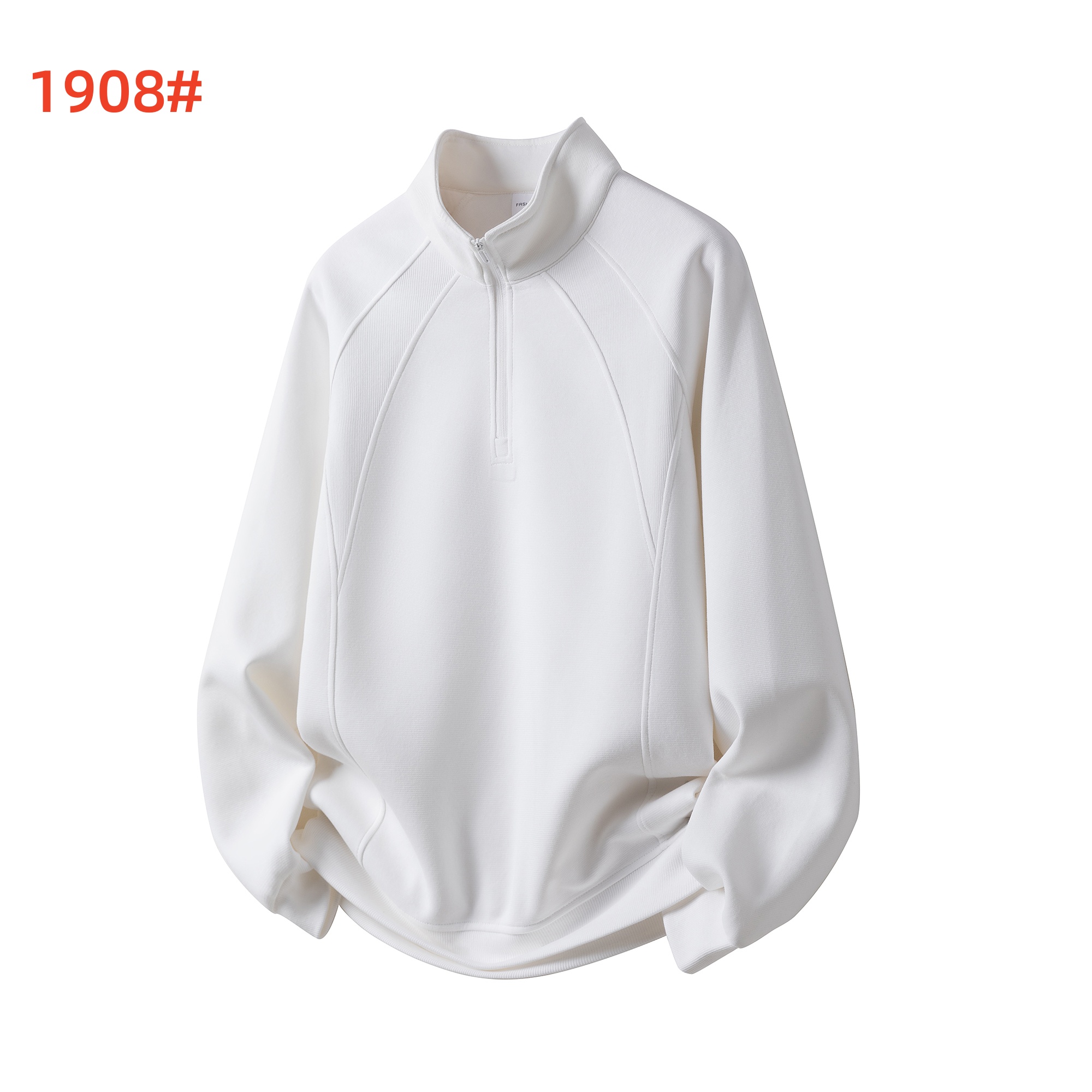
Sampling, minimum orders and size runs
Samples are produced within 5 to 7 working days after the tech pack is confirmed. Bulk production takes 15 to 25 days once the sample is approved and the fabric is in stock. Custom orders start at 200 pieces per style, and the quoted price depends on fabric weight, zipper specifications, decoration method and packaging, rather than on the style alone.
The size run is the detail buyers most frequently revise. A quarter zip is a layering garment, so the fit decision usually depends on whether it is intended to be worn over a shirt or a t-shirt. Wearing it over a shirt means one size of ease at the chest; over a t-shirt means no ease. Getting this wrong is not a grading issue and cannot be fixed by simply adding a size, so it is best resolved during the sample stage.
Color is the other variable. Stock colors can be mixed in small quantities and shipped within three days; custom dyeing follows Pantone matching and falls within the production lead time, so color approval must be obtained before the fabric is ordered.
Common questions from buyers before placing an order
Should we order a hooded version instead?
Only if the hood serves a functional purpose in the market. A quarter zip is lighter, packs smaller, and layers easily under a jacket; a hood adds bulk around the neck and completely changes the collar construction. Many buyers who initially inquire about zip-up hoodies ultimately choose a pullover once the layering application is clear.
Can the zipper be replaced with a different slider?
Yes, for custom runs. Auto-lock, semi-auto-lock and branded cord pulls are all available, and the choice should be made in conjunction with the placket length, as a long placket with a plain slider will slide open during wear.
What is the minimum order quantity for mixed orders?
Custom runs are quoted per style and per color, starting at 200 pieces. Stock colors can be mixed below this quantity, which is the usual approach for testing two or three colorways before committing to a full production run.
For most buyers, the practical solution is two styles: a technical jersey pullover for mild weather and a fleece quarter zip for the colder months, in matching core colors so the range appears as a cohesive collection. Specifications, color options and stock status for each are listed on the product pages, and the factory can provide a quote for mixed orders once the size breakdown and decoration method are finalized.
Share to:


