The Art of Mountain Sweatshirts: Fabric Choices, Panel Design, and Construction Quality
The creation of mountain cotton sweatshirts tailored for wholesale, encompassing the 63.5/36.5 blend, drop shoulder placement, curved panels, contrast piping, decoration options and bulk minimums.
2026/11/18
Reading volume: 8
News Details
A crewneck sweatshirt is the least technical garment in a winter range and the one that shows a factory's standard most clearly. There is no zip to distract, no hood to hide behind: the collar rib, the cuff length, the way the shoulder sits and whether the hem recovers after washing are all visible at a glance. That is why buyers who compare custom sweatshirts suppliers often decide on a plain sample rather than on a decorated one.
This guide covers the mountain cotton sweatshirt family produced in our Guangzhou factory: the 63.5/36.5 blend behind it, the four constructions in the range, what separates a structured drop shoulder from a sagging one, and the order details that decide a repeat.
Why the blend is 63.5% cotton and 36.5% polyester
Mountain cotton is not a brand name for one mill's cloth; in this range it describes a specific recipe. The cotton share gives the hand that buyers recognise as "sweatshirt fabric" — soft, dry, slightly matt under light. The polyester share is what stops the garment collapsing: it adds tensile strength along the seams, resists surface pilling where the sleeve rubs against a bag strap, and holds the dimensions after commercial laundering.
Move the ratio toward pure cotton and the garment feels better on the first day and worse in the third month: a 100% cotton loopback relaxes at the cuff, grows at the elbow and loses the boxy line that made it sell. Move too far toward polyester and the fabric develops a sheen that reads as cheap in a photograph.
Weight matters as much as the ratio. A heavy knit holds a crisp, volumetric shape; a lighter knit of the same blend drapes and clings. If a buyer needs the boxy streetwear silhouette, the weight has to be specified before the sample is cut, because it cannot be added later without re-patterning the whole garment.
Four constructions in one fabric family
The same cloth supports four distinct products, and the difference between them is structural rather than decorative.
| Style | Neckline | Sleeve | Signature detail | Stock colours |
|---|---|---|---|---|
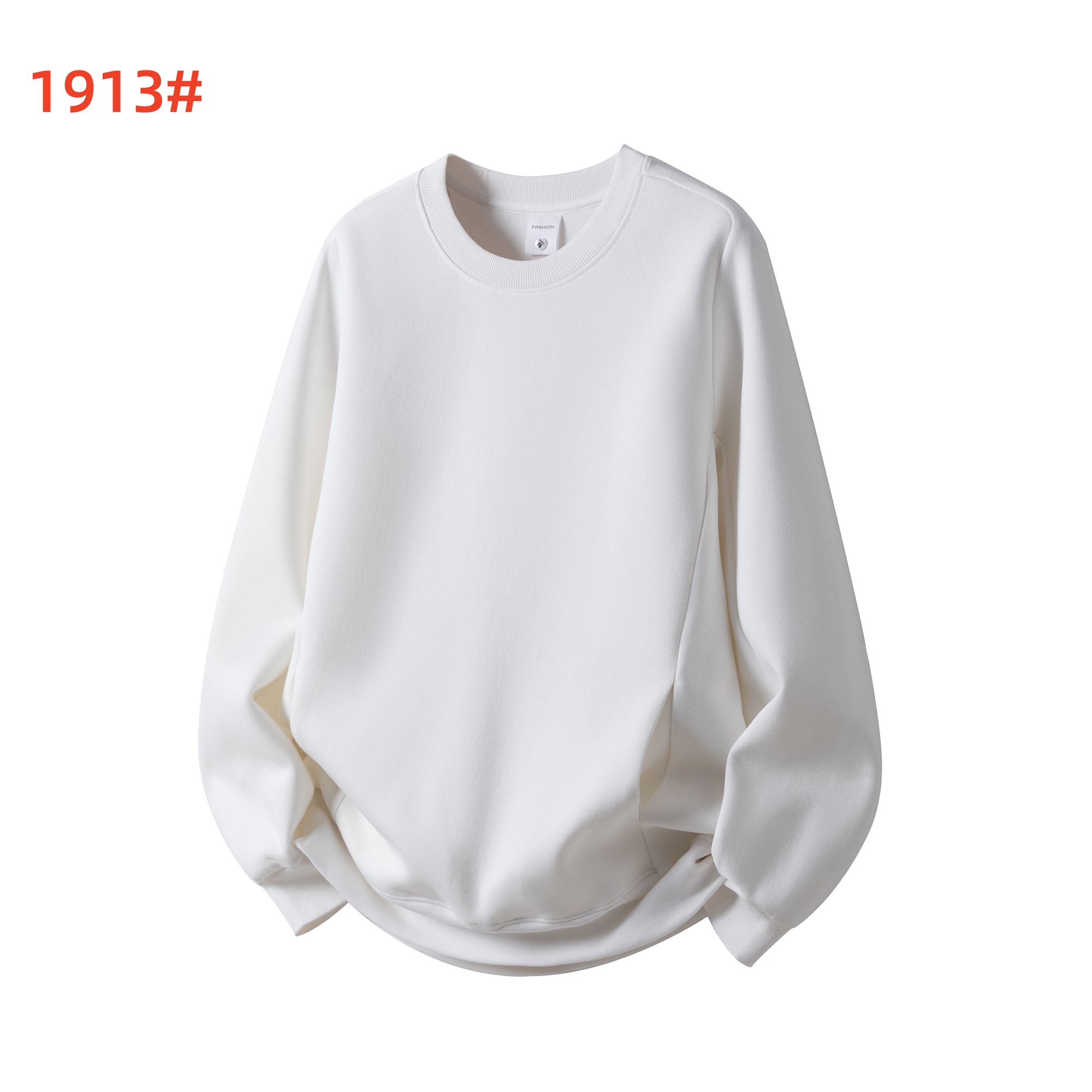
| 1913 | Rib crew | Drop shoulder | Concealed side seam pockets | Light grey, white, black |
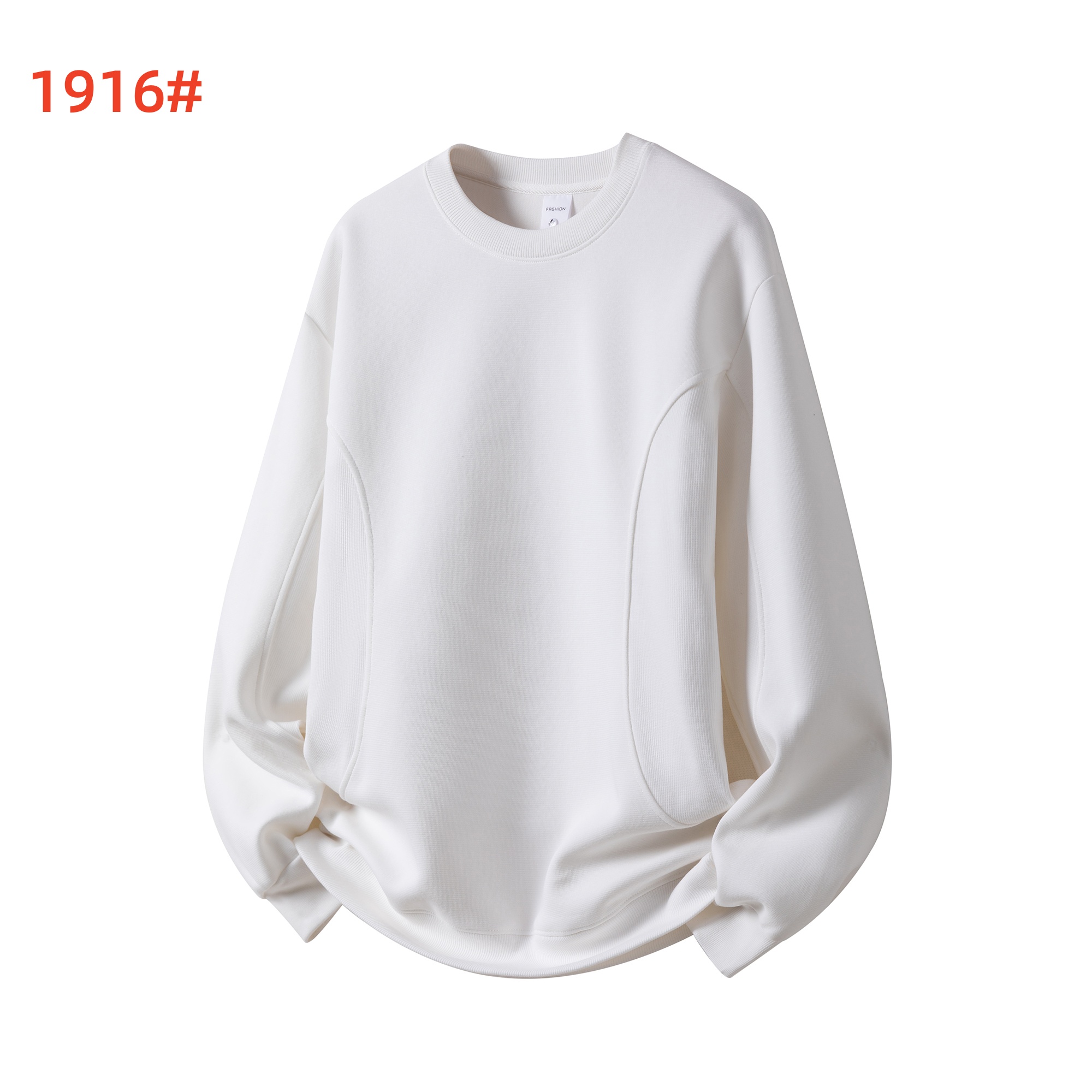
| 1916 | Rib crew | Drop shoulder | Curved side panel seams | Light grey, white, khaki, pine blue, black |
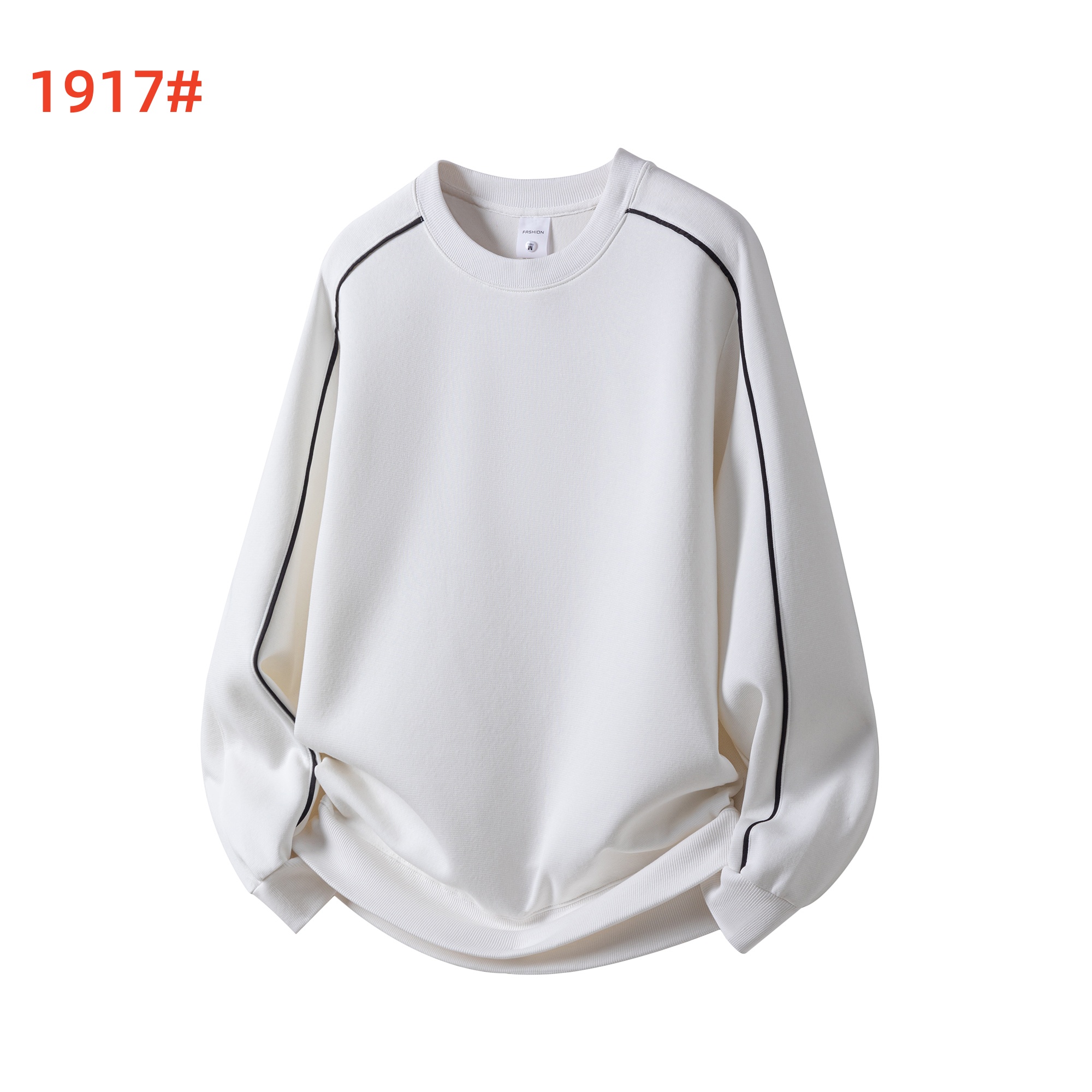
| 1917 | Rib crew | Drop shoulder | Contrast piping on shoulder and sleeve seams | Light grey, white, black |
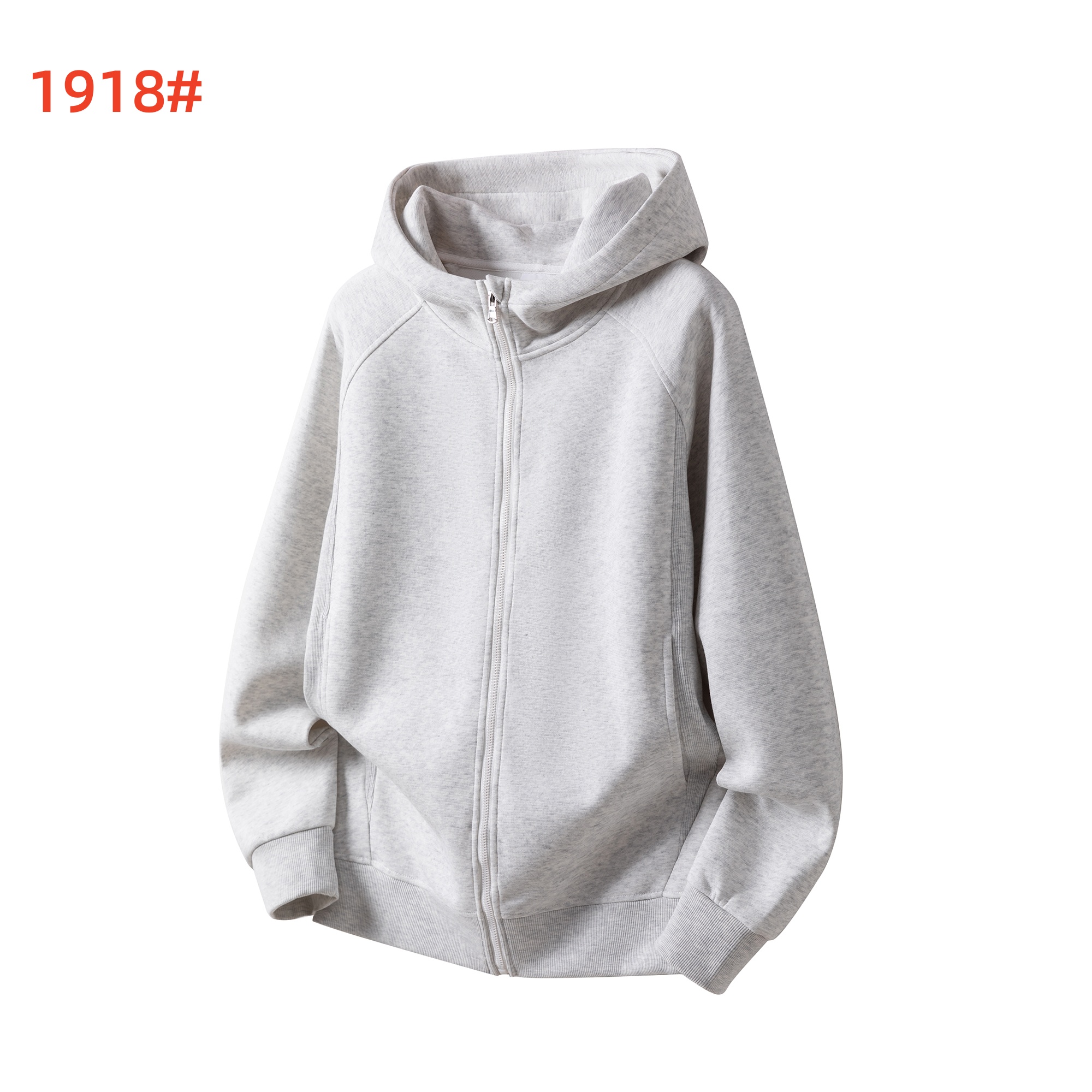
| 1918 | High stand hood | Raglan | Full-length metal zip | Light grey, pine blue, black |
The mountain cotton crewneck sweatshirts in style 1913 are the plain option, and the concealed side pockets are the detail that separates them from a generic blank: the pocket opening is cut into the side seam so the front stays clean, which is what a print or an embroidery placement needs.
The curved panel mountain cotton sweatshirts in style 1916 add arched vertical inserts down each side. They narrow the silhouette without changing the chest measurement, which is why boutique labels use them when the same block has to suit two markets with different fit expectations.
The contrast piping mountain cotton sweatshirts in style 1917 run a fine piping line along the shoulder and sleeve seam. It is a varsity reference and it is also the most demanding of the four to produce, for reasons covered below.
The full-zip hooded mountain cotton sweatshirts in style 1918 convert the same fabric into outerwear: a high stand hood, a metal zip running into the collar, raglan sleeves and a plush interior face. Where the three crewnecks are mid-layers, this one is sold as a jacket.
Where a sweatshirt starts to look cheap
Three details carry most of the perceived quality, and none of them appears in a price quote.
The first is the collar rib. A crew neckline is a circle of ribbing under constant strain. If the rib is too narrow, the neckline waves after a few washes; if the seam that joins it is a plain lockstitch, the thread snaps and a hole opens at the back of the neck. On this range the neck, cuffs and hem are double-stitched for shape memory, which is the minimum for a garment that will be laundered commercially.
The second is cuff and hem depth. A shallow 4 cm cuff looks unfinished on a heavy body; 6 to 7 cm reads as deliberate and holds the sleeve shape better. The hem follows the same logic: a deep ribbed hem keeps the boxy line, a narrow one lets the body ride up.
The third is shoulder placement. On a drop-shoulder construction the seam sits below the shoulder point, and how far below is a design decision that has to be made before grading. Two centimetres is the difference between a relaxed streetwear fit and a garment that looks one size too large. Because the seam is not structural on a knit, a factory can move it easily — which is exactly why it should be fixed in the tech pack rather than left to the pattern cutter.
Piping and panel seams: the two alignment risks
Contrast piping is a narrow strip of fabric folded over a seam, and it exposes every millimetre of error. The piping has to enter the collar seam at the same point on both sides, follow the shoulder line without wavering, and finish at the cuff at the same height. On a drop shoulder the seam curves, so the piping has to be cut on the bias; a straight cut will pucker on the curve and the puckers show up as a wavy line in photographs.
Curved side panels carry a different risk. The two panels must be mirror images, and the seam must sit at the same distance from the underarm on both sides. Where the panel meets the hem rib, the alignment has to be square to the grain, or the hem will twist. Both faults are checked at final inspection, and both are cheaper to prevent at the cutting table than to repair after the fact.
Decorating a heavy knit
A smooth, tightly knit mountain cotton face takes high-density screen print, puff print, silicone transfer and direct embroidery. The heavy body is an advantage here: a thick garment does not distort under the screen, so a large front print stays square.
Puff print is the technique that suits this fabric best, because the raised ink sits on a surface that will not collapse around it. Direct-to-garment printing works better on the lighter constructions than on the heaviest, where the ink sits on top of a dense face instead of bonding into it.
Embroidery needs a backing on the chest of a drop-shoulder style, because the fabric stretches across the panel during the stitch.
Sizing, stock and the 200-piece minimum
The crewnecks and the hooded style are stocked from M to 3XL, in three to five colours depending on the style. Buyers who need XS or 4XL should raise it before the sample stage, because an additional size is a new grade rather than an extra line on the chart.
Stock colours can be mixed at low volume and dispatched within three days from the 5,000 square metre warehouse, which is the normal route for a first order: two or three colours, one size curve, sold through before a custom run is committed. Custom orders start at 200 pieces per style and per colour, with sampling in 5 to 7 working days and bulk production in 15 to 25 days once the sample is approved and the fabric is in house.
Custom dyeing is quoted against a Pantone reference and sits inside the production lead time, so the colour has to be approved before the fabric is ordered. On a 63.5/36.5 blend the polyester share takes dye slightly differently from the cotton, which is why a lab dip is approved on the actual blend rather than on a cotton swatch.
Quality control on a plain garment
Because there is no print to inspect, the AQL inspection on these styles concentrates on construction: seam strength at the armhole and side seam, piping or panel symmetry, rib recovery after a wash test, and dimensional consistency across the size run. Buyers running their own third-party inspection are welcome to arrange it at the factory before packing, and the most useful thing to bring is a sealed approved sample, because most disputes on a plain sweatshirt are about a measurement or a shade rather than a defect.
Questions buyers ask before ordering
Is mountain cotton the same as French terry?
No. French terry describes a knit structure with loops on the inside; mountain cotton describes the fibre blend used here. The two can overlap in hand feel, but the specification that matters on a purchase order is the composition and the weight, not the trade name.
Can the crewneck be made with a hood?
Yes, as a separate style rather than a modification. A hood changes the neckline construction, the collar rib and the fabric consumption, so it is a new pattern and a new sample.
How many colours can one custom run carry?
Custom orders are quoted per style and per colour from 200 pieces. Mixed colour runs within that minimum are common, and stock colours can be mixed below it for a first order.
For most winter ranges the practical structure is one plain crew as the volume blank, one paneled or piped crew as the fashion piece, and the full-zip hooded style as the outer layer, all in the same core shades so the range reads as one collection. Specifications, colour ranges and stock status for each are listed on the product pages, and the factory can quote a mixed order once the size breakdown and decoration method are fixed.
Share to:


