Custom T-Shirts: Fabric Weight, Cotton Types and Print Surface
News Details
Meaning of Heavyweight Fabric in Cotton T-Shirts
Fabric weight in gsm is the specification buyers debate most on a cotton t-shirt, and for good reason: it drives hand feel, opacity, print performance and unit cost at the same time. In trade sourcing, short sleeve cotton tees are commonly grouped into bands — roughly 160–180 g for lightweight layering, 180–210 g for standard retail tees, and 220–260 g for heavyweight bodies that hold a structured silhouette. The number that governs your order, however, is the one measured on the finished fabric, with a tolerance written into the purchase order.
Two details change how a weight behaves in practice. First, yarn construction: a 230 g fabric built on a double-ply yarn reads denser and smoother at the same weight than a single-ply knit, because two finer yarns twisted together fill the knit more evenly. Second, finishing: a garment wash relaxes the fabric before the customer ever wears it, which reduces post-purchase shrinkage and softens the hand without changing the weight specification materially.
Combed Cotton and the 230g Washed Heavyweight Tee
Combing is the step that removes short fibres from the yarn before spinning, and it is the difference between a tee that stays smooth after ten washes and one that fuzzes on the surface. On our heavyweight cotton t shirts in the 230 g breathable line, the fabric is 100% combed cotton spun as a double-ply yarn, garment-washed for softness and minimal shrinkage, and cut in a slight drop-shoulder loose fit across ten colours from M to 3XL.
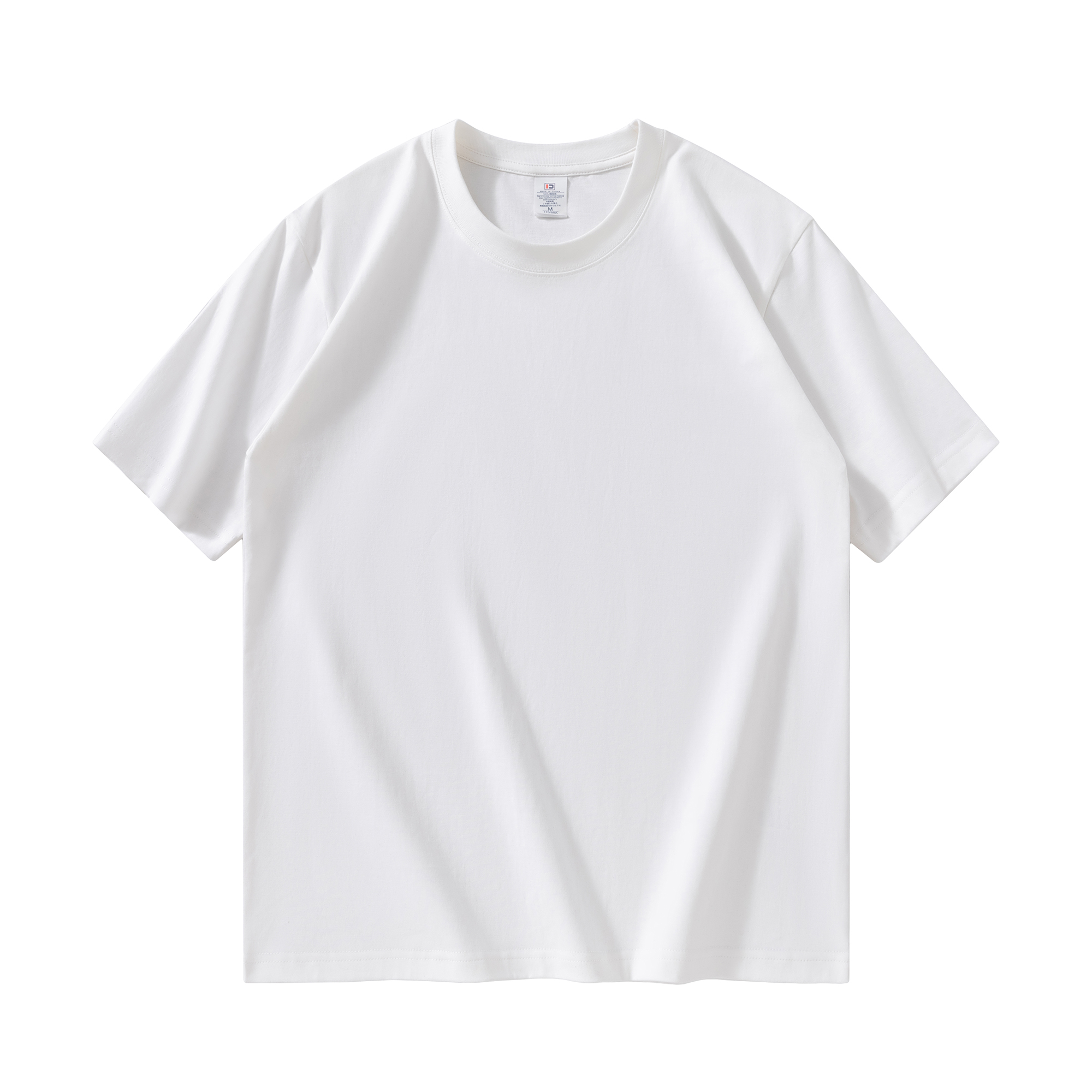
The weight band also has commercial consequences beyond feel. A 230 g body holds screen print and puff ink without distorting at the shoulders, drapes like a garment rather than a base layer, and reads as a premium blank on the shelf — which is why streetwear and corporate blank programmes settle in this band. The trade-off is freight weight and a slower dry, both of which belong in your landed-cost calculation rather than being discovered after the first container.
Roma Cotton: The Blended Alternative
Roma (often written roman) cotton is a double-knit structure, and its value for custom programmes is stability. A cross-knit Roma fabric resists pilling, holds colour and keeps its dimensions through repeated washing, which makes it the practical choice when a range will live through many care cycles. Our roma cotton t shirts at 220 g use a 63.6% cotton / 36.4% polyester blend in a 45S double-ply cross-weave, finished with liquid ammonia for surface softness and deep colour, and finished with bonded taping at key strain points so the interior has no abrasive seams.
The blend ratio is a specification decision, not a compromise. Pure cotton maximises moisture absorption and natural hand; the polyester share in a Roma knit adds dimensional stability and pilling resistance. For corporate programmes and activewear-casual lines that are washed weekly, the blended Roma body usually outlasts a pure cotton equivalent of the same weight.
Antibacterial Finishes: What the Ratings Actually Describe
Physical antibacterial finishes now appear across the line — 5A on the 230 g combed cotton body and 7A on the Roma fabric — covering bacteria, dust mites, viruses, odour and mould. The ratings describe the level and breadth of physical protection built into the fabric treatment, not a chemical coating that washes away; the 7A Roma finish is specified to hold its antibacterial performance across 150 machine washes.
For buyers, two things matter. First, ask which claims are certified and request the test basis, because antibacterial performance is a compliance topic in several retail markets. Second, understand that the finish does not change how the fabric is decorated — print and embroidery parameters are decided by the surface, not by the treatment.
Stretch Cotton: Where Comfort Stretch Fits
Between rigid heavyweight cotton and full synthetic performance fabrics sits the comfort stretch category: cotton-rich knits with a small elastane content that move with the wearer without reading as activewear. These bodies suit retail tees, travel and everyday programmes where fit retention matters — the elastane keeps the neckline and cuffs from bagging out, which is the most common age-related complaint on cotton tees.
When specifying stretch cotton, state the elastane percentage and the recovery expectation, because recovery is what separates a stretch tee that holds its shape from one that relaxes into a different garment after a month of wear.
Drop-Shoulder Fit: A Silhouette Decision, Not a Size Adjustment
The drop-shoulder cut — where the shoulder seam falls below the natural shoulder point — has become the default silhouette for heavyweight streetwear blanks. It changes the garment in three measurable ways: the body reads boxier at the same chest measurement, sleeve length is measured differently from a set-in sleeve, and the shoulder drop reduces the need for precise shoulder fit across a size run. That last point matters for e-commerce ranges sold without try-on, because it widens the fit tolerance that still looks intentional on the body.
When grading a drop-shoulder pattern, the drop distance and the sleeve width have to be graded together with the body, or the silhouette drifts between sizes. Confirm this on the graded sample set, not just the base size.
Print Surface: Why Yarn and Finish Decide Decoration Quality
Decoration quality is decided before the printer touches the garment. A tight, low-fuzz knit face — like the double-ply combed cotton surface or the liquid-ammonia-finished Roma face — takes crisp screen print, high-density and puff ink, DTG graphics and fine embroidery. A looser, fuzzier surface scatters fine detail and forces heavier ink deposits, which changes both the look and the per-unit cost at volume.
Practical checks at sampling: approve decoration on the actual fabric weight and colour you will order, not on a generic swatch; on dark colours, confirm opacity of under-base prints; and on bonded-seam fabrics like the Roma body, keep artwork clear of the taped zones so the decoration does not sit across a raised edge.
Choosing a Fabric for Your Programme
| Programme | Fabric direction | Why |
|---|---|---|
| Streetwear, premium blanks | 230 g combed cotton, garment wash, drop shoulder | Structured drape, strong print surface |
| Corporate, high-wash-frequency | 220 g Roma cotton blend, bonded taping | Dimensional stability, pilling resistance |
| Everyday retail, travel | Comfort stretch cotton knit | Fit retention, softer drape |
The full custom t shirts range covers heavyweight combed cotton, Roma cotton and comfort stretch bodies across men's and unisex fits, with weight, colour and decoration developed to specification.
Frequently Asked Questions
Is 230 gsm too heavy for a summer T-shirt?
Not necessarily. A washed, breathable 230 g combed cotton regulates heat better than its weight suggests because absorption and air movement matter as much as mass. For consistently hot climates, lighter weights remain the safer default; for streetwear positioning, 230 g is the mainstream premium band.
Does a polyester blend make a T-shirt worse?
No — it changes what the garment is good at. The polyester share in a Roma knit buys dimensional stability and pilling resistance at the cost of some natural-hand feel. For programmes washed frequently, the blend usually wears better over its lifetime.
What should we fix before bulk production?
Four records: the finished-fabric weight with tolerance, the fibre composition, the lab dip per colour, and the decoration proof on the actual fabric. Bulk is then checked against that record instead of opinion.


