In the apparel supply chain, "wholesale women's long sleeve tops" represent one of the most foundational SKU categories for buyers sourcing private label and ready-made inventory. From performance tees to layering knit tops, the fit block, panel layout and selected fabric determine long-term sell-through rates. This guide covers production specs and fabric choices for buyers ordering bulk women's long sleeve tops, with technical context for manufacturers and sourcing teams.
How women's long sleeve tops are specified for wholesale: the difference between rib and four-way stretch, where panel seams sit, how sizes are graded, and what a 200-piece custom run requires.
2026/11/16
Reading volume: 1
News Details
In the case of women's long-sleeved tops, a centimeter difference in the side seam is the deciding factor that determines whether a style sells well or is returned. Buyers comparing wholesale women's apparel suppliers usually see the same fabric names and identical flat-lay photos, so the real difference lies in the fit block, the positioning of the seams, and the way sizes are scaled.
This guide explains how the women's long-sleeved garment line is produced in our Guangzhou factory: the available silhouettes, the corresponding knit fabrics for each style, the position of the panels, and the requirements for a custom batch of 200 pieces before cutting begins.
Why fit block takes priority over fabric selection
Men's long-sleeved T-shirts can often be scaled by simply adding width to the same pattern. Women's styles rarely work with this approach, as the waist, chest, and hem require different amounts of ease. A standardized size scaling results in a top that fits well at the shoulders but is loose at the waist, or vice versa. This defect only appears in product reviews long after the goods have been shipped.
Therefore, three measurements are finalized before selecting any fabric: shoulder width, chest (flat half-measurement), and garment length. The size chart published for each style lists these measurements for each size, allowing buyers to compare the proposed fit with garments already selling well in their market, rather than making judgments based solely on photos.
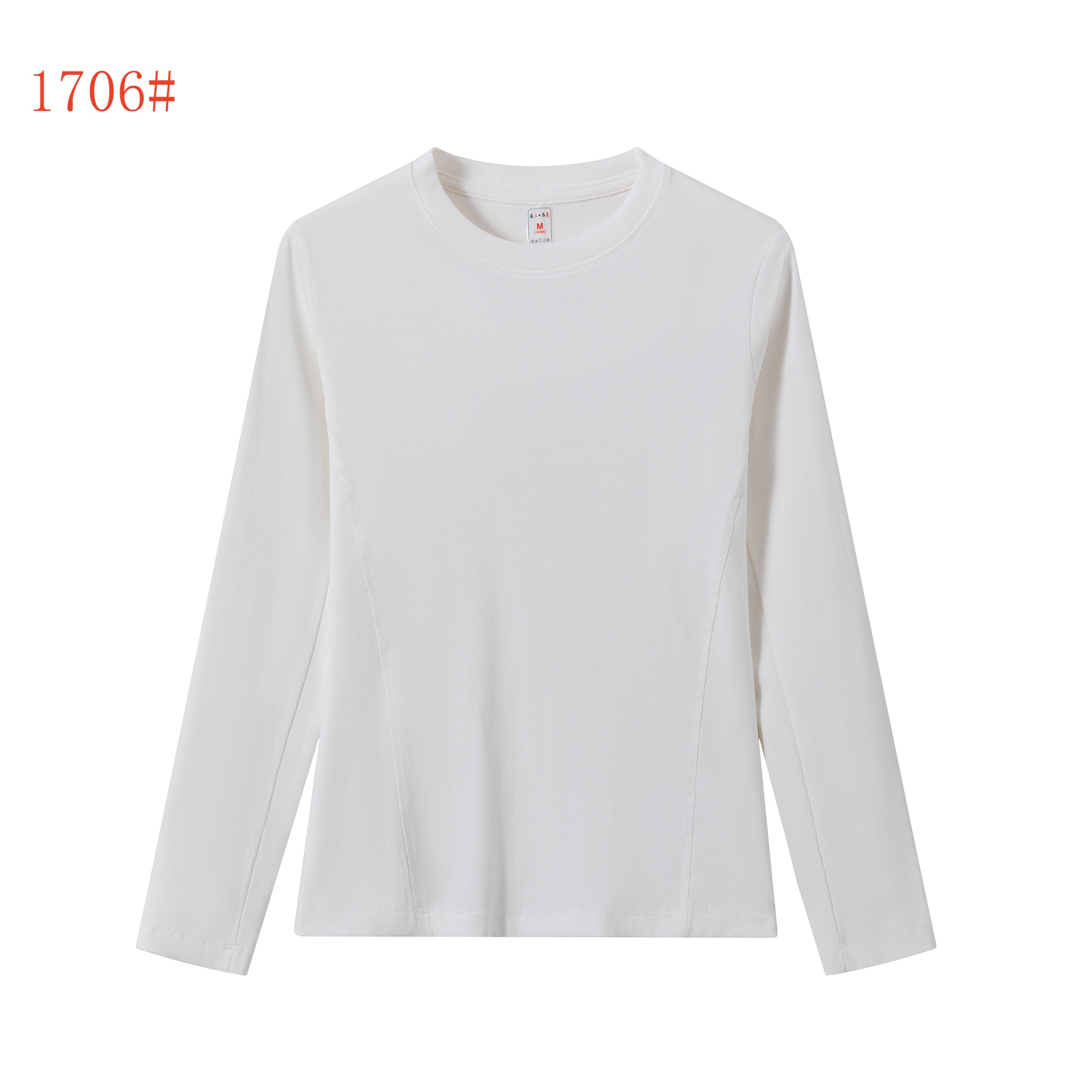
The gap between two styles in the same size is easy to underestimate. Size M of Style 1706 has a shoulder width of 36 cm, a chest width of 43 cm, a garment length of 56 cm, and a sleeve length of 55 cm. Size M of Style 1703 measures 37.5 cm, 48 cm, 63.5 cm, and 57 cm, respectively. The latter features a loose athletic cut that ends below the hip, while the former is a form-fitting base layer that sits at the waistband. Both are suitable for different end uses, and mixing them in a single purchase order without checking can lead to size-related complaints.
Four silhouettes and their intended uses
- Quarter-zip mock neck: the women's quarter-zip long-sleeve shirt of Style 1703 features raglan sleeves, a stand collar, a hidden half-zip placket with a semi-automatic locking slider, and curved side seams. Suitable for golf, training, and corporate casual wear, as this top can be worn as an outer layer.
- Ribbed crewneck base layer: the women's ribbed crewneck long-sleeve top of Style 1706 uses a micro-ribbed knit fabric, features princess seams on the front, an elastic crew neckband, and set-in sleeves. Designed to be worn under jackets or vests, it is typically purchased in black, off-white, and mocha for autumn and winter use.
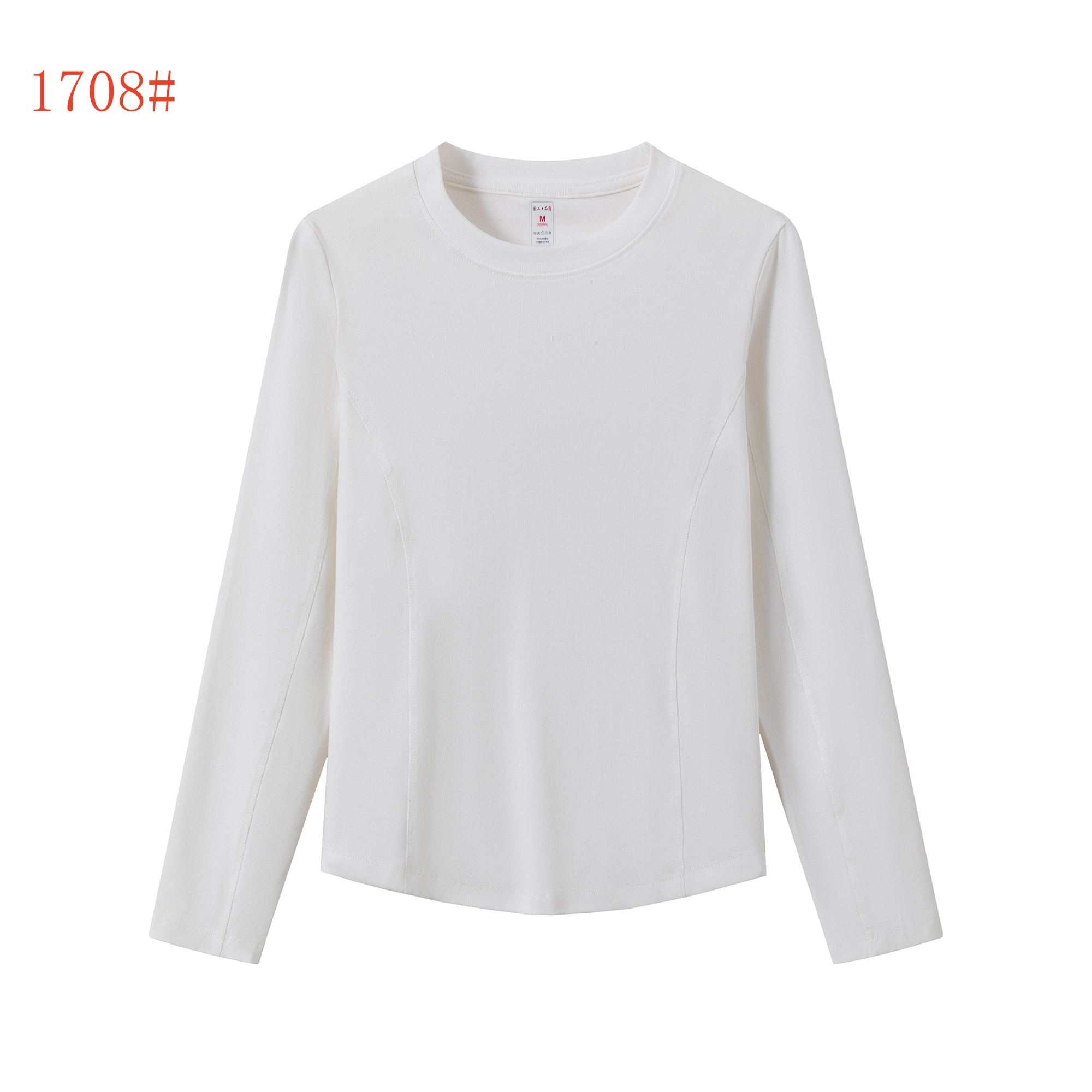
- Curved hem crew neck: the women's curved hem long-sleeve shirt of Style 1708 features a curved scoop hem, ergonomic side paneling, and flatlock stitching. Designed for yoga and stretching to provide ample coverage, avoiding the issue of straight hems riding up.
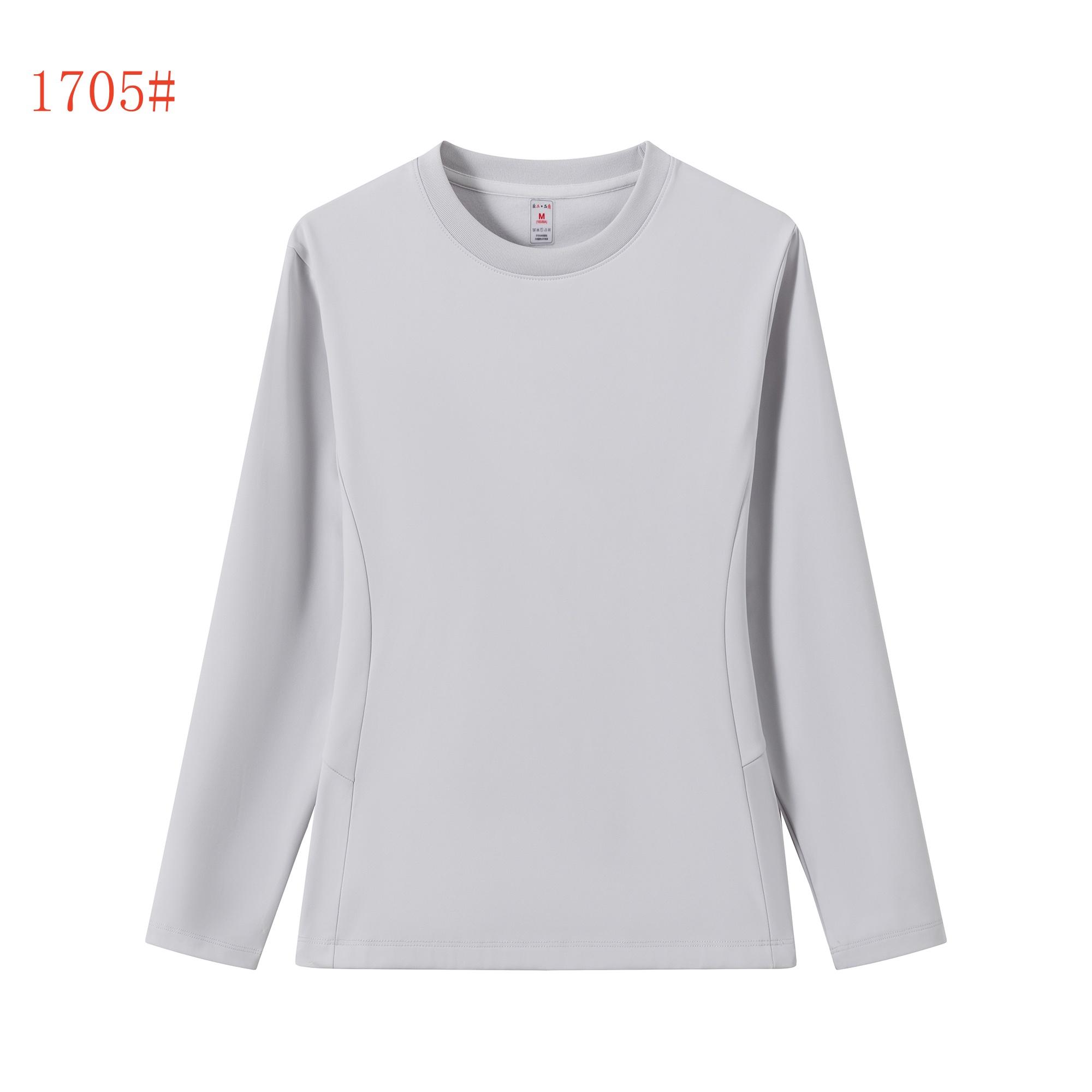
- Paneled crew neck: Style 1705 retains the crew neckline while adding curved side panels that follow the waist contour, made from the same four-way stretch fabric as the quarter-zip style.
Buyers who need a single style to cover multiple selling scenarios usually start with the quarter-zip style, as the stand collar gives the impression of outerwear in product photos. Buyers targeting studio fitness, layering, or thermal markets usually start with the ribbed crewneck, as its unit price is easier to justify, and there are no zippers to inspect upon arrival.
Key Differences Between the Four Styles on Paper
| Style | Neckline | Sleeve Construction | Seam or Hem Details | Most Suitable For |
|---|---|---|---|---|
| 1703 | Stand collar, hidden quarter-zip closure | Raglan sleeves | Contoured side seams | Golf, training, corporate environments |
| 1705 | Crew neck | Set-in sleeves | Curved side panels | Everyday activewear |
| 1706 | Ribbed crew neck | Set-in sleeves | Front princess seams | Base layers, layered wear |
| 1708 | Crew neck | Set-in sleeves | Curved scoop hem, flatlock stitching | Yoga, studio fitness, additional coverage needs |
The Impact of Knit Fabric Selection
The micro-ribbed fabric of Style 1706 is not merely decorative. The vertical ribs provide lateral stretch, which is why this garment can be designed to fit closely without a zipper while still being easily pulled on over the head. The trade-off is resilience: ribs that are heavily stretched at the chest do not recover their original shape as reliably as dense, flat knit fabrics, so the pattern must incorporate slightly less negative ease than four-way stretch styles.
The four-way stretch knit used for Styles 1703, 1705, and 1708 has different characteristics. It stretches along both the lengthwise and crosswise grain, features a smooth surface and quick-drying texture, and maintains a wrinkle-free line at the zipper placket. This is a more forgiving option for buyers who cannot inspect samples in person, as it allows for broader fit tolerances before the garment looks ill-fitting.
Neither knit provides significantly more warmth than the other. If a buyer needs a true cold-weather base layer, the honest answer is to select a different fabric weight, rather than a different seam. Communicating this prior to order placement is more cost-effective than explaining it afterward.
Seams, Hems, and Stitching: Where the Actual Fit Is Created
The princess seams on Style 1706 run from the armholes to the hem, shaping the waist without darts. On ribbed knit fabrics, these must be sewn with stretch stitches that move with the material; standard lockstitching will tear the first time the garment is pulled on. The same principle applies to the neckband, which is double-stitched to prevent sagging after repeated washes.
The curved hem on Style 1708 exists for a specific reason. A straight hem shifts away from the body when the wearer bends or reaches overhead, which is why studio fitness and yoga buyers request extra length at the front and back. The scoop shape adds this length without adding bulk at the sides, and the flatlock stitching ensures the inner seam is low-profile enough to avoid skin irritation.
For paneled styles, the side seams are not straight lines. They curve inward at the waist and outward at the hip, and on Style 1703, this curve continues through the raglan seams to the sleeve caps. This curve is what distinguishes a women's fit block from a proportionally scaled-down men's block, and it is also the first detail to check when samples arrive: lay the garment flat and observe whether the side seams run straight or follow the body's natural contours.
Grading, sampling, and minimum order quantity of 200 pieces
Women's styles are graded from size M to 2XL according to the published size chart. Buyers who need sizes XS or larger should inform us before sampling, as adding a new size at the end of a production run requires a new grade, rather than simply adding a row to an existing size chart.
Sampling takes 5 to 7 working days. Bulk production takes 15 to 25 days after sample approval and receipt of the fabric, with a minimum order of 200 pieces per style for custom orders. In-stock styles can be ordered in smaller quantities with mixed sizes, which is the standard approach for first orders: test two or three colors in small volumes, then place a custom order once the fit is confirmed.
Sample costs consist of the pattern-making fee and shipping charges, with the pattern-making fee credited toward bulk orders. If the fabric or fit block is adjusted after the first sample, a second sample fee applies. Therefore, it is beneficial to finalize the fit block, knit fabric, and color before the first pattern is cut.
Decoration, labels, and packaging
Smooth four-way stretch surfaces are compatible with silicone heat transfers, high-density printing, and fine embroidery. Ribbed fabrics are less forgiving: thick plastisol prints applied across ribs will crack along the grooves, and embroidery on form-fitting ribbed panels requires backing to prevent the seam from puckering. Custom orders can also include heat-sealed neck labels, woven hem tags, and branded polybags.
Individually polybagged garments are shipped in standard export cartons containing 50 to 100 pieces. Custom hang tags, care labels, and printed outer cartons are quoted separately, and must be confirmed before production begins—not just before shipment—because labels are attached during the finishing process.
Common questions from buyers before placing an order
Can the same fit block be used for all four styles?
No. The ribbed crewneck and four-way stretch styles require different amounts of ease, so a single block would compromise the fit of at least two styles. Maintaining separate blocks allows Style 1706 to fit closely to the body while Style 1703 remains relaxed across the chest.
Which style is most suitable for first-time orders?
If your market responds to outerwear styling, the quarter-zip style is ideal, as it does not require a layered wear concept to be attractive. The ribbed crewneck is more budget-friendly. Both are available in core colors, reducing lead time for first orders.
How can we confirm the fit without visiting the factory?
Fit samples are photographed and measured against the size chart before shipment, and the sample is also sent via courier so buyers can try it on. Measurements are taken flat, so the values on the size chart can be replicated using a tape measure upon receipt.
If a product line requires both a layering piece and an outer layer, a practical combination would be one ribbed crewneck and one quarter-zip style in matching core colors, plus a curved hem style for studio fitness or yoga accounts. Specifications for each style are available on the product pages, and the factory can provide a quote for mixed orders once colors and size breakdowns are finalized.
Share to:


