women full zip hoodie fit hood construction zipper construction
How a women's full-zip hoodie is graded and built: the 1701 block from M to 2XL, the two-panel hood, zip stabilising and pocket setting, and what to check before bulk.
2026/11/24
Reading volume: 0
News Details
A women's full-zip hoodie is the garment most often ruined by scaling down a men's pattern. The body gets shorter, the shoulders narrow, and the result still reads as a man's hoodie in a smaller size, because the relationships between shoulder, chest, body length and sleeve did not change with the measurements. Buyers who have sourced this category know the symptom: a zip that waves, a hood that stands up empty, pockets that sit too low.
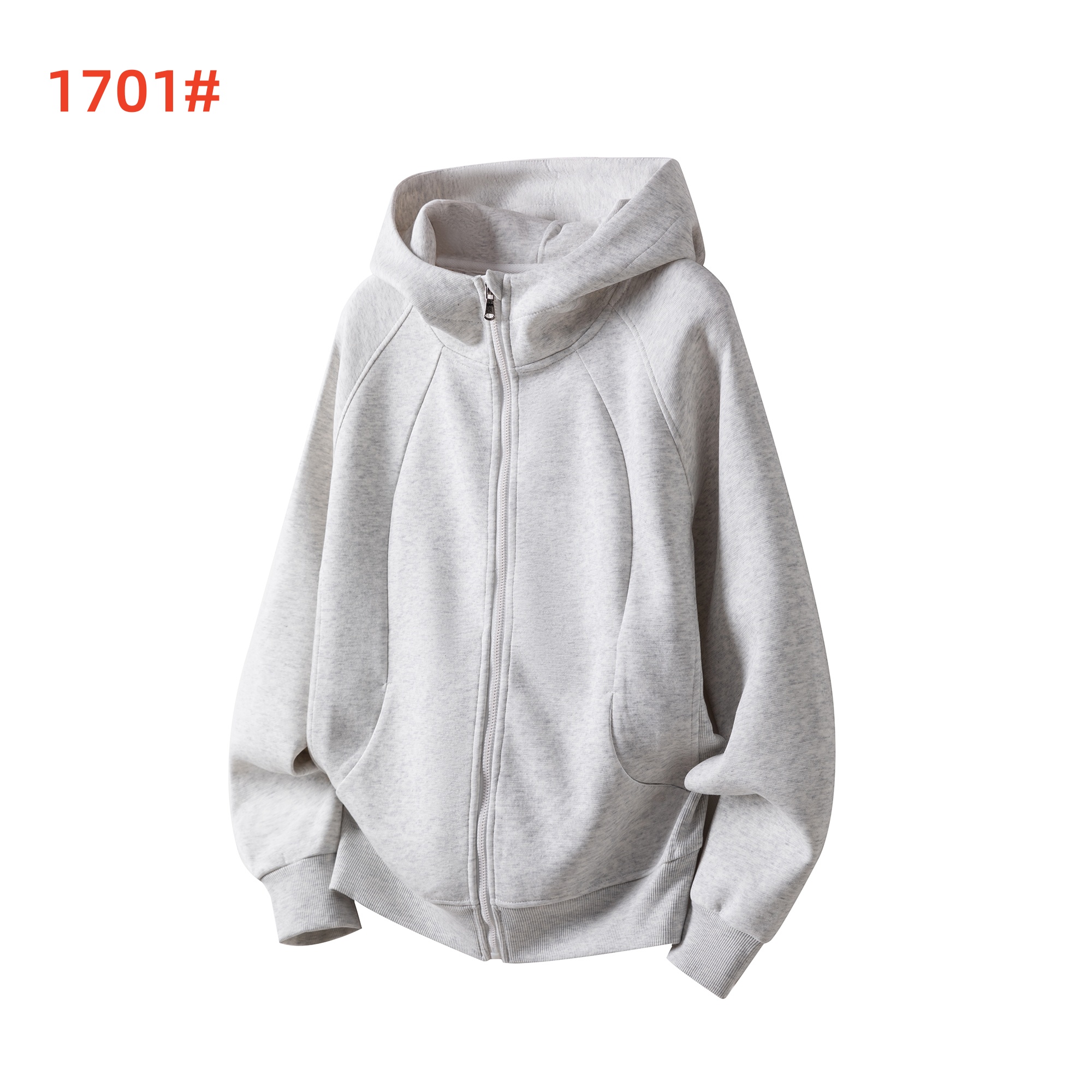
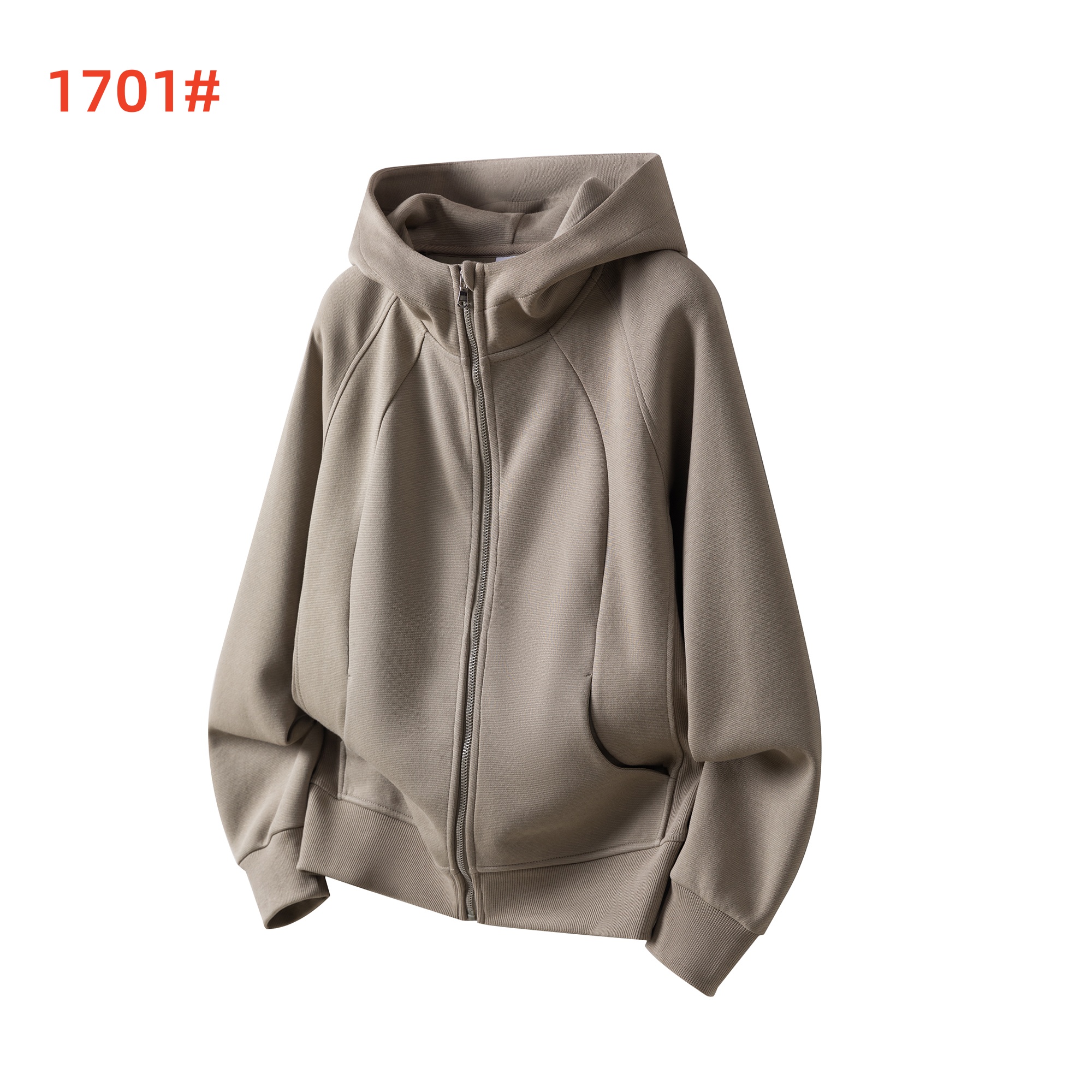
Style 1701 is a women's full-zip hoodie cut on its own block rather than graded down from a men's shape. It runs M to 2XL in a soft fleece, shown here in light grey marl and khaki, with a two-panel hood, a metal zip, ribbed cuffs and hem, and front pockets set into curved panel seams. This guide covers the block in numbers, why the grading moves the way it does, how the hood and the zip decide whether the garment hangs cleanly, and what to fix in the tech pack before a bulk run.
The block, in numbers
Measurements below are garment measurements in centimetres, taken flat, with a tolerance of 1-3 cm on a hand-measured production sample.
| Size | Shoulder | Chest (1/2) | Body length | Sleeve |
|---|---|---|---|---|
| M | 40 | 50 | 58 | 58 |
| L | 41.5 | 53 | 60 | 59 |
| XL | 43 | 56 | 62 | 60 |
| 2XL | 44.5 | 59 | 64 | 61 |
Set against the men's full-zip block we produce in the same fabric family, the difference is not a uniform reduction. At M, the women's shoulder is 40 cm against 52 cm on the men's, the chest is 50 cm against 53 cm, and the body length is 58 cm against 68 cm - a 10 cm difference in length for a 3 cm difference in chest. That ratio is the whole point of a separate block: the garment ends at the hip rather than at the seat, and the sleeve stays long enough to cover the wrist because women's arms are not proportionally shorter than the body.
Buyers used to men's grading often read 58 cm as short. On a women's hoodie worn over a legging or a high-waisted jean, 58 cm is a hip-length garment, and the ribbed hem is designed to sit at the hip bone rather than hang past it. If a market wants a longer line, say so in the tech pack before sampling, because adding length to this block also moves the pocket and the panel seam.
How the grading moves, and why
Across the size run the chest grows 3 cm per size at the half measure, the shoulder 1.5 cm, the body length 2 cm and the sleeve 1 cm. Three of those four numbers are deliberate choices rather than arithmetic.
Chest at 3 cm. A 6 cm full-chest step is a women's convention; on a men's block the same step is usually 5 cm. The larger step keeps the fit from becoming boxy at the top of the range, where a smaller step would leave a 2XL that is only marginally wider than an XL.
Shoulder at 1.5 cm. The shoulder is the dimension that decides whether a dropped-shoulder style still looks intentional at 2XL. At 1.5 cm per size the seam sits slightly past the shoulder point on every size, which is the relaxed look the block is cut for; a 1 cm step would make the larger sizes look tight across the back.
Length at 2 cm. Body length is graded evenly, so the proportion of the garment does not change across the run. This is the number buyers should check against their own best-seller rather than against a size chart in the abstract.
Sleeve at 1 cm. The sleeve grows more slowly than the chest because a set-in sleeve on a wider body does not need a proportionally longer arm. Where a market has a taller customer base, the sleeve is the first measurement to extend, and it can be extended on its own without re-cutting the body.
The hood: two panels, one seam, and the depth question
The hood on this style is built from two panels joined on a centre seam, with a folded front edge. That is the simpler of the two common constructions, and on a women's hoodie it is usually the better one: a two-panel hood lies flatter at the back of the neck when it is down, and it takes less fabric than a three-panel hood with side gussets.
The number that matters is depth. A hood that is too shallow stands away from the head at the crown and looks empty when worn down; one that is too deep collapses over the shoulders and pulls the front neckline. The practical check is to fit the hood on a head form with the zip closed to the top and confirm three things: the front edge clears the brow, the centre seam sits on the crown rather than behind it, and the hood does not lift the front body when the wearer turns their head.
The front edge is finished with a folded band rather than a raw hem. That band is what stops the edge from stretching out of shape when the hood is pulled on, and it is also where a drawcord would be fitted. On this sample no drawcord is used, which is a deliberate clean-finish choice: no cord, no eyelets, no cord ends to test. Where a buyer needs a drawcord, it should be specified with the eyelet position and the cord length, because both affect the pattern of the hood band.
The zip, and the waviness problem
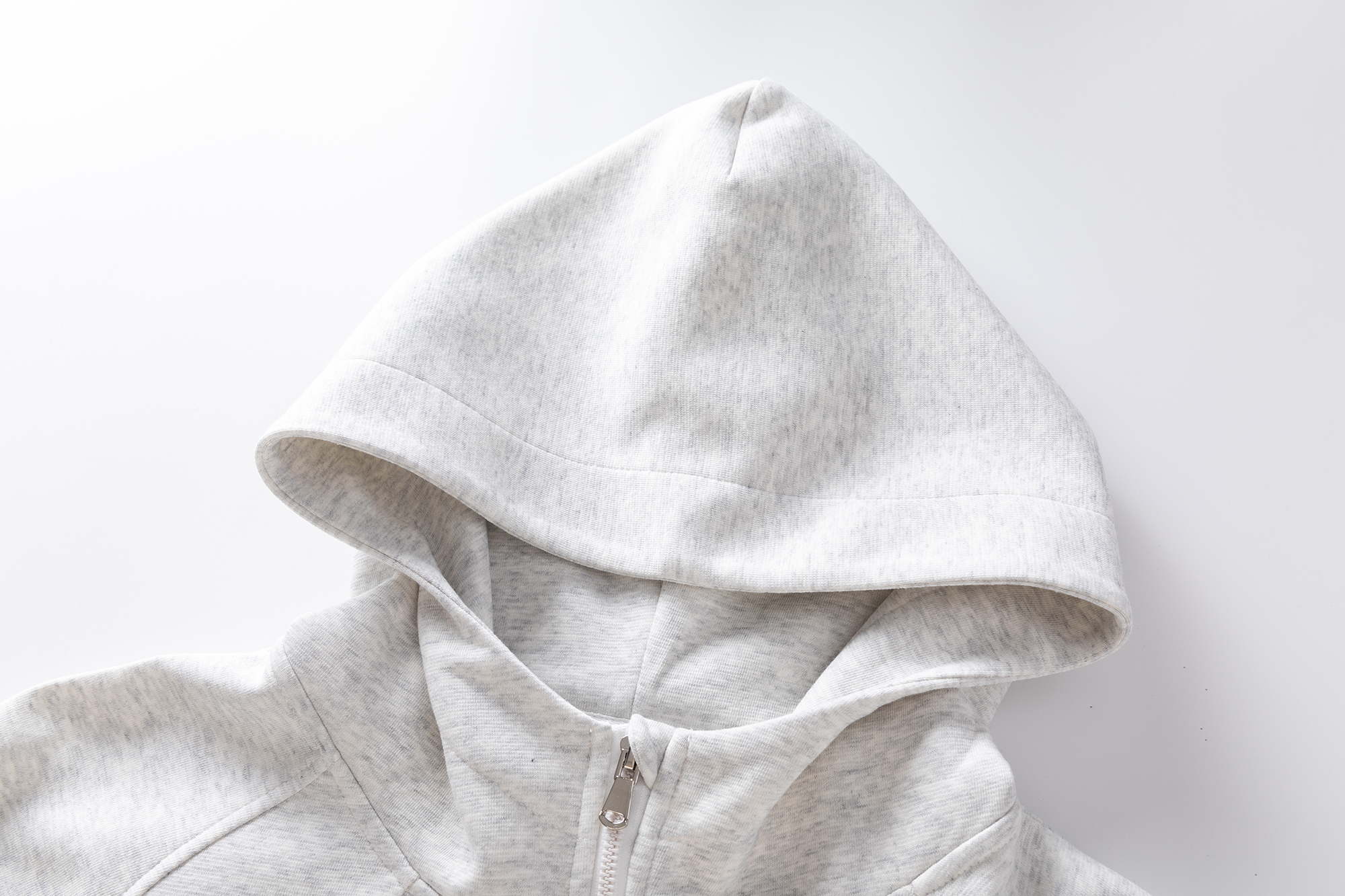
A full-zip hoodie lives or dies on the front. Three decisions control whether the zip runs flat after washing.
Zip length against front length. The zip is cut to the finished front length after the hem rib is attached, not to the body length before it. A zip that is 1 cm short pulls the hem up into a curve; one that is 1 cm long ripples at the bottom. Both faults are visible on a hanger and impossible to correct after bulk.
The guard. A zip guard - a strip of self-fabric behind the zip tape - stops the slider from catching the wearer and hides the tape edge when the zip is open. On a soft fleece it also adds body to the front edge, which is what keeps the placket from curling.
Stabilising the tape. Fleece stretches, and a zip sewn into a stretchy edge will wave after the first wash unless the front edge is stabilised. A fusible tape along the seam line, applied before the zip is set, is the usual fix; a strip of the same knit is not, because it stretches with the body.
For a bulk order, ask for a wash test on the sealed sample - three home launderings at 40 C, hung to dry - and judge the front edge on the garment rather than on the pattern. A zip that waves by 3 mm on the sample will wave more on a bulk lot, because the fabric is washed in rope form and the front edge takes the strain.
Pockets and panel seams
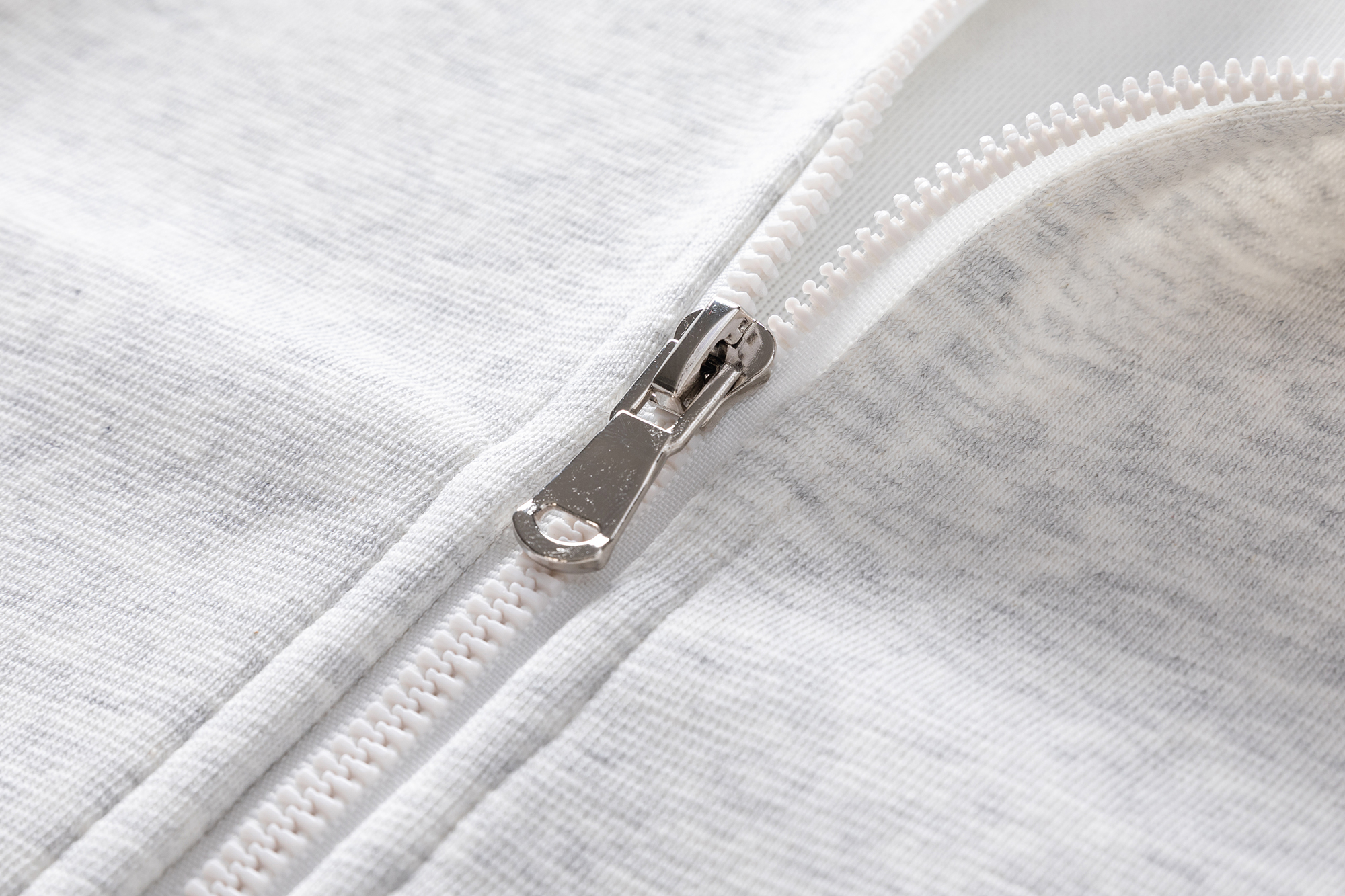
The front pockets on this style are not patch pockets sewn on top of the body. They are set into the curved panel seams that run from the shoulder, past the chest, and down to the pocket opening - a construction that does two things at once. It gives the front a shaped line that reads as tailoring rather than sportswear, and it moves the pocket opening onto a seam, so there is no pocket bag edge to press and no topstitch to keep straight.
Pocket depth should be specified in the tech pack. A pocket that reaches the hem rib is comfortable but adds fabric and weight at the bottom of the garment; a shallow pocket looks correct and is useless. For a women's hoodie at this length, a pocket that ends 4-6 cm above the hem rib is the practical range.
Cuffs, hem and the ratio that holds the shape
The cuffs and hem are 2x2 rib, attached with a ratio of rib length to opening width that is set per size. Too little ratio and the hem flares; too much and it gathers the body into a bubble. On a women's block the hem is also where the garment's silhouette is decided: a hem that is 2-3 cm narrower than the chest gives the blouson shape this style is cut for, while a hem as wide as the chest reads straight and boxy.
The rib itself should contain elastane and be tested for recovery, not just for stretch. A rib that stretches 100 percent and recovers 80 percent will be loose at the cuff after ten wears. The test is simple: stretch the cuff to its limit, hold for ten seconds, release, and measure after a minute. A good rib returns to within 5 percent of its original length.
Fabric, and what a marl does to a bulk lot
The light grey shown here is a marl - two or more differently dyed fibre lots spun together, so the surface reads as a soft, slightly irregular grey rather than a flat one. Marl is forgiving on the body and unforgiving in bulk: because the effect comes from the fibre blend, the shade is set at spinning rather than at dyeing, and a new fibre lot can shift the grey by a visible step. Approve the yarn lot as well as the garment, hold a physical standard per shade, and shade-band the rolls before cutting, because a marl rolled from two lots will show a line across a panel.
Minimums, lead times and inspection
Custom orders start at 200 pieces per style and per colour, with sampling in 5 to 7 working days and bulk production in 15 to 25 days after sample approval and fabric arrival. Stock blanks are held in depth - more than 200,000 units in a 5,000 square metre warehouse - and stock orders can start at ten pieces with dispatch inside three days, which makes a wear test or a colour check practical before a bulk commitment.
Inspection follows the AQL standard across the lot, with manual checks on zip straightness, hood symmetry, pocket mouth strength, rib recovery, seam alignment at the panel curves, and measurements against the approved sample. Zip straightness is the check that matters most on this style: measure the front edge from the centre of the neck to the bottom stop on a flat garment, and compare it with the pattern. A deviation of more than 5 mm will read as a wave when worn.
For buyers building a women's outerwear range, the men's full-zip version of the same idea is listed as full-zip hooded mountain cotton sweatshirts, and the women's programme that includes this block sits under custom women's hoodies. The wider range of weights and builds is listed in the custom hoodies and sweatshirts category.
Questions buyers ask before ordering
Can this block be extended to XS or 3XL?
Yes, but as separate patterns rather than extra steps. The chest step of 3 cm holds at both ends, while the shoulder and body length need re-drafting: an XS cut by formula ends up with a shoulder that is too wide for the chest, and a 3XL cut by formula ends up short in the body. Both should be sampled before they are offered.
Does the hood need a drawcord?
Not for a clean-finish programme. A drawcord adds eyelets, cord ends and a cord-length safety question, and on a hood this shallow it mostly decorates. Where a market expects one, specify the eyelet position and cord length together, and test the cord ends to the applicable standard.
Why does the zip wave after washing?
Because the front edge stretched before or during sewing. Fleece has more stretch than the zip tape, so the tape has to be stabilised with a fusible before the zip is set, and the zip has to be cut to the finished front length. If a sample waves, check those two points before changing the zip supplier.
The practical next step for a women's range is a stock order in the two anchor shades, worn for a week with the zip open and closed, then washed twice and judged on the front edge. A hoodie is a garment people live in - the faults that matter show up in wear, not on a hanger.
Share to:


